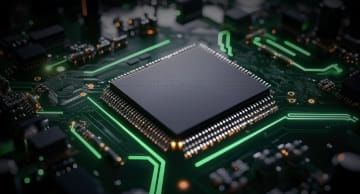
Embedded systems are small computing units built into larger devices to perform specific tasks. They combine hardware and software to create a device that can sense, process, and respond.
They power ordinary and advanced technology such as:
Smartphones and wearables
Washing machines and home appliances
Cars and electric vehicles
Medical devices
Industrial machines
Satellites and spacecraft
For example, a smartwatch uses an embedded system to track heart rate. A car uses one to control braking and airbags. An industrial machine uses one to monitor speed, pressure, or temperature.
In simple terms, embedded systems help devices work automatically, accurately, and often in real time.
Embedded systems engineering is in demand because more products now need software-controlled hardware. Cars, medical devices, wearables, smart appliances, factory machines, robots, and IoT products all depend on embedded systems to work safely and reliably.
It is also a specialized career path because the work needs both hardware and software knowledge. An embedded systems engineer must understand microcontrollers, embedded C, sensors, circuit behavior, communication protocols, debugging, and real-time performance.
The demand is also linked to growth in electronics, automotive technology, semiconductor design, IoT, robotics, and connected devices. Deloitte’s 2026 Global Semiconductor Industry Outlook projects global semiconductor sales to reach US$975 billion in 2026, supported by demand for AI infrastructure and advanced computing.
That is why embedded systems engineering remains one of the most specialized hardware-software career paths in 2026.
You will learn how embedded devices are developed, connected, tested, and controlled with code. The aim is to create systems that can sense signals, respond in real time, and function successfully within the constraints of limited memory and power.
Key concepts that are covered in the free embedded system courses include:
Embedded C programming on controllers like Arduino, STM32, and ARM Cortex
Connecting sensors, LEDs, motors, displays, buttons, and communication modules
Working with UART, SPI, I2C, Bluetooth, Wi-Fi, and CAN fundamentals
Writing low-level code to regulate hardware behaviour
Understanding RTOS tasks, scheduling, interrupts, timers, queues, and memory handling
Detecting code flaws, verifying signal behavior, and improving device reliability
Applying concepts through hands-on work with microcontrollers, IoT devices, and real-world hardware setups
These principles will allow the learner to go from fundamental embedded C programming to developing workable embedded systems for IoT, robotics, consumer electronics, automotive systems, and industrial devices.
Free embedded system courses are best suited for learners who want to understand how software controls physical devices. They are useful for:
Beginners with no prior hardware experience who want to explore embedded systems before choosing a paid program
Electronics and electrical engineering students with existing knowledge of circuits looking to progress into firmware and RTOS tracks
Computer science students who are interested in hardware-level programming
Working professionals in electronics, IoT, robotics, or automation who want to progress into RTOS specializations
Engineers who want to refresh microcontroller, embedded C, or firmware basics
An ideal learner should have basic knowledge of electronics, such as circuits, voltage, current, sensors, and microcontrollers. Some programming exposure also helps, especially in C, C++, or Python.
The free embedded system courses cover beginner-friendly boards first, then move into advanced microcontroller and real-time concepts.
Some common platforms include:
Arduino: A foundational platform to start with sensors, basic embedded C/C++, input-output control, and small hardware projects
STM32: An intermediate platform for learners who want to practice microcontroller programming and firmware development
Raspberry Pi: Linux-based embedded projects, IoT applications, and hardware-software experiments
ESP32: Commonly used for Wi-Fi, Bluetooth, IoT, and connected device projects
ARM Cortex: Low-level programming, memory, interrupts, and direct device control
For real-time systems, many courses introduce FreeRTOS. Learners get exposure to tasks, scheduling, timers, queues, interrupts, and resource handling.
Embedded systems are used in devices that need to read inputs, make decisions, and respond automatically. Some of the real-world applications for embedded systems include:
Automotive electronics: They control braking, airbags, engine systems, battery management, parking sensors, infotainment, and driver-assistance features.
Medical equipment: They power patient monitoring, insulin pumps, imaging systems, portable diagnostic instruments, and wearable health trackers, all of which require high accuracy.
Consumer IoT: They power smart speakers, home security systems, wearables, connected appliances, thermostats, and smart lighting.
Aerospace: They aid in navigation, communication, flight control, engine monitoring, and spacecraft operations.
Embedded systems make gadgets faster, more reliable, and safer to operate in real-world conditions across various sectors.
Embedded systems are about writing software that controls hardware. The code runs inside devices like cars, wearables, medical equipment, appliances, and industrial machines. Often, it must work with sensors, microcontrollers, limited memory, low power, and real-time responses.
IoT development takes the process a step further by adding connectivity. An IoT device can collect data from hardware and send it to a mobile app, cloud platform, dashboard, or another device. A smart thermostat, for example, reads room temperature through embedded software and uses IoT features to share that data with a phone app.
Traditional software engineering is usually centered on building programs people use through a screen, such as websites, mobile apps, business tools, dashboards, or backend systems. The work is more about user flows, data handling, databases, APIs, and cloud services. It does not usually involve writing code that directly controls sensors, motors, chips, or other physical hardware.



 Basic Networking Concepts