
Applied AI Courses
Top 3 Applied AI Courses for 2026
Ranked by learner rating across our 49 Applied AI programs
Rank #2
Professional Certificate in Applied Generative AI & Agentic AI
Cohort starts: 22nd Oct ’26 1 Days Left
Empowering Millions Through Professional Learning
- switchup4.6
- Trustpilot4.6Excellent
- Course Report4.5
Applied AI Skills You Will Build
The core capabilities you’ll practice across Applied AI programs
- Enterprise Compliance
- Agent Orchestration
- LLMOps Evaluation and Monitoring
- Autonomous AI Systems
- MultiAgent Systems
- Retrieval Augmented Generation
- Vector Databases
- Tool Integration
- Prompt Engineering
- Intelligent Automation
- Agentic AI Frameworks
- Observability Setup
- AI Copilots
Universities and Technology Partners Behind These Programs


Advanced Executive Program In Applied Generative AI
- 4.9 out of 5
- 4.1K+ learners
- 5 months
- Intermediate to advanced
View more about Advanced Executive Program In Applied Generative AI
Advanced Executive Program In Applied Generative AI is an online certificate program offered with IITM Pravartak, rated 4.9 out of 5 by 4.1K+ learners. Runs 5 months. Best for experienced practitioners.
Professional Certificate in Applied Generative AI & Agentic AI
- 4.8 out of 5
- 300+ learners
- 12 weeks
Cohort starts: 22nd Oct ’261 days left
- Intermediate to advanced
- Live cohort
View more about Professional Certificate in Applied Generative AI & Agentic AI
Professional Certificate in Applied Generative AI & Agentic AI is a live cohort certificate program offered with Duke University, rated 4.8 out of 5 by 300+ learners. Runs 12 weeks. Best for experienced practitioners.
Applied Generative AI and Agentic AI Specialization
- 4.9 out of 5
- 5.1K+ learners
- 12 weeks
Cohort starts: 22nd Oct ’261 days left
- Intermediate to advanced
- Live cohort
View more about Applied Generative AI and Agentic AI Specialization
Applied Generative AI and Agentic AI Specialization is a live cohort certificate program offered with Virginia Tech, rated 4.9 out of 5 by 5.1K+ learners. Runs 12 weeks. Best for experienced practitioners.
Applied Generative AI Specialization
- 4.8 out of 5
- 4K+ learners
- 16 weeks
Cohort starts: 29th Oct ’268 days left
- Intermediate to advanced
- Live cohort
View more about Applied Generative AI Specialization
Applied Generative AI Specialization is a live cohort certificate program offered with Michigan Engineering Professional Education, rated 4.8 out of 5 by 4K+ learners. Runs 16 weeks. Best for experienced practitioners.
Applied Generative AI Specialization
- 4.5 out of 5
- 600+ learners
- 16 weeks
- Intermediate to advanced
View more about Applied Generative AI Specialization
Applied Generative AI Specialization is an online certificate program offered with UC Santa Barbara Professional and Continuing Education, rated 4.5 out of 5 by 600+ learners. Runs 16 weeks. Best for experienced practitioners.

Applied AI Overview
Applied AI courses build end-to-end capability, from model development to workflow integration and deployment validation.
Skills developed include:
Machine learning fundamentals, deep learning concepts, reinforcement learning basics, and evaluation methodologies.
Tools covered include:
Python, OpenAI, Hugging Face, Azure AI Studio, LangChain, Copilot, Gradio, and Jupyter.
Applied AI courses are a strong fit for anyone who wants to implement AI in real workflows, not just understand concepts. Globally, these learner profiles benefit the most:
-
Students and early-career professionals aiming for AI/ML roles and a portfolio that shows end-to-end delivery (data → model/LLM workflow → evaluation)
-
Data analysts and BI professionals who want to move from reporting to prediction, segmentation, forecasting, and automation
-
Data scientists looking to strengthen production thinking, evaluation discipline, deployment patterns, monitoring, and iterative improvement
-
Software engineers shifting into AI-centric work: integrating models/LLMs into apps, building APIs, and using retrieval (RAG) and agent workflows
-
QA and automation engineers who need to test AI features, validate outputs, and support release readiness with measurable checks
-
Product managers scoping AI use cases, defining success metrics, and balancing performance, risk, and cost
-
Business teams and leaders (marketing, ops, finance, strategy) applying AI for decision support, workflow automation, customer experience, and operational efficiency
If your goal is to ship reliable AI features, with grounding, evaluation, and guardrails, applied learning is the most direct route.
Most applied AI courses don’t require strict prerequisites, but having the right baseline makes the learning smoother because the work is hands-on and project-driven.
A typical “ready to start” profile looks like this:
-
Basic coding comfort (especially Python): you should be able to read, tweak, and run simple scripts
-
Foundational data literacy: working with tables/CSV files, basic statistics, and understanding common evaluation metrics at a high level
-
Problem-solving mindset: breaking a use case into steps, testing outputs, and iterating based on results
If you’re coming from analytics, software development, QA/automation, or product roles, you can often ramp quickly because the workflows feel familiar (requirements → build → test → improve).
Applied AI courses support roles focused on building, evaluating, and shipping AI features, such as:
-
AI Engineer
-
Machine Learning Engineer
-
Applied Data Scientist
-
Applied AI Specialist
-
AI Solutions / Consulting Associate
-
BI Developer (AI-enabled)
-
MLOps / Model Deployment Associate
Organizations now depend on artificial intelligence to power risk modeling, revenue growth strategies, supply chain optimization, and customer experience initiatives. As a result, professionals who can move from concept to applied AI deployment are in high demand.
Know more about Applied AI Courses
Our applied AI courses are designed for professionals who want to use artificial intelligence to solve real business and technology problems, not just understand how AI works in theory. They focus on translating AI concepts into practical applications that improve operations, decision-making, and customer experiences.
Theoretical AI vs. Applied AI Courses
|
Aspect |
Theoretical AI |
Applied AI |
|
Focus |
Emphasizes mathematical models, algorithms, and foundational research |
Centers on problem-solving using existing AI tools and technologies |
|
Goals |
Advances scientific understanding and develops new AI solutions |
Delivers practical solutions and applications that address real business needs |
|
Learning Approach |
Involves abstract reasoning, proofs, and algorithmic theory |
Relies on projects and experimentation with datasets and software |
|
Skill Sets |
Requires strong background in mathematics, statistics, and computer science theory |
Requires knowledge of computer programming, exploratory data analysis, and familiarity with AI frameworks |
|
Career Paths |
Suited for research scientists, academic roles, and those developing new AI models or theories |
Ideal for data scientists, AI engineers, and professionals deploying AI in various industries |
As organizations increasingly rely on data-driven systems and intelligent automation, applied AI has become essential across industries. From predictive analytics and natural language processing to computer vision and workflow automation, applied AI connects technical capability with measurable business outcomes. Our online applied AI courses are designed to match this demand.
What’s the Market Demand for Applied AI?
Applied AI is no longer a niche capability. It is now mainstream in day-to-day operations.
|
IBM reports 42% of enterprise-scale companies surveyed have deployed AI. |
The World Economic Forum lists “AI and big data” among the fastest-growing skills for 2025–2030. |
Applied AI skills sit at the intersection of technical execution and business impact. Industries using applied AI include IT and SaaS, healthcare, finance, retail and e-commerce, and manufacturing. Artificial intelligence powers risk analysis, growth strategy, supply chain optimization, and customer engagement, making implementation expertise highly valuable.
Why Choose Simplilearn for Applied AI Courses?
Our courses offer structured, job-focused applied AI learning that can help you grow in your current role or transition to new roles. We provide live instructor-led training, hands-on labs, projects, and exposure to modern GenAI workflows like RAG and agentic AI. Plus, you will get an industry-recognized certificate and career support like interview preparation and resume optimization to help you apply skills confidently.
Connect with our learning consultant to get all your questions answered about programs, faculty, and more
Tools and Platforms Used in Our Applied AI Courses
Get hands-on with the platforms and tools covered across our Applied AI programs















Recommended Learning Materials for Upskilling
Explore free webinars, tutorials, career guides, and practical reads to go deeper
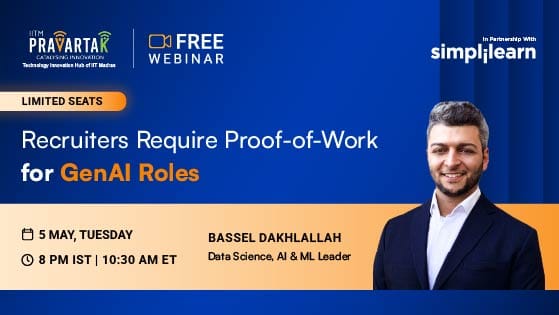
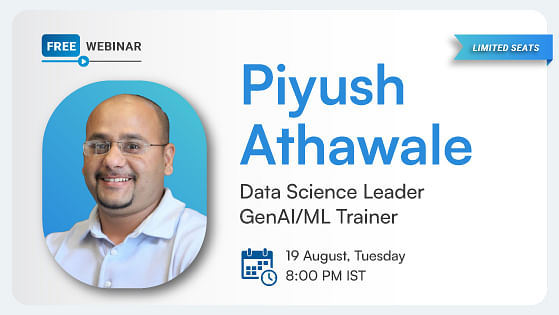
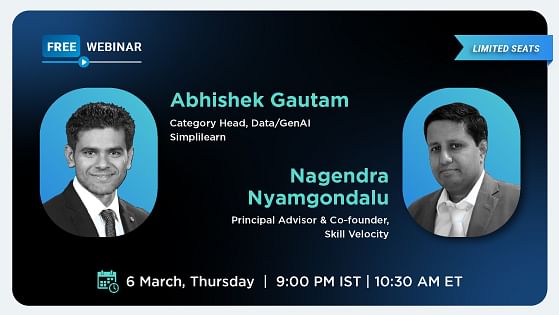
Upcoming Webinars - Free Masterclasses
Articles and Ebooks That You Can Access For Free


Applied AI Instructors and Mentors

Amitendra Srivastava
Chief Data Scientist at Intelytica,
Amitendra’s expertise lies in utilizing data analysis and machine learning techniques to solve complex business problems and drive strategic decisions. As Chief Data Scientist, he leverages the power of data to create value and drive innovation.

Armando Galeana
Founder and CEO at Ubhuru Technologies,
A seasoned data science leader, with extensive experience in digital transformation. Throughout his career, Armando has leveraged his vast expertise in AI & ML to build infrastructure, create new lines of business and drive global implementations.

Madhusudhanan Baskaran
IITM Pravartak - Principal Faculty,
Dr. Baskaran, with 31 years of experience in AI/ML and a Ph.D. in AI, is a Principal Faculty at IITM Pravartak, has expertise spanning Deep Learning, NLP, IoT, and Generative AI, and noted contributions in multimodal AI systems, drone data analytics, and AI-driven healthcare solutions.

Max Goff
GenAI Consultant , Ex KPMG Spark,
Max is a Seasoned Data Scientist and big data engineer with 30+ years of experience in ML, big data, and computer programming. Known for his expertise in GenAI, NLP, and process improvement, Max has consistently driven innovation and growth across organizations.

Raghav Goel
Generative AI & Data Science Consultant,
A passionate and successful corporate trainer who has delivered 150+ training sessions for corporates in India, Middle East, USA, and South East Asia for corporate clients like Publicis Sapient, KPMG, Capgemini, Coforge, ITC, DXC, Huawei, and IBM.

Vijay Rajandram, PhD
Chief Data Officer, Northern Trust Asset Management,
Vijay Rajandram, PhD is a highly accomplished and strategic leader with extensive experience in transforming business models, driving business development, delivering digital transformations, and embedding data in business decisions.
Applied AI Courses: Frequently Asked Questions
Applied AI Courses teach you to build and deploy AI capabilities that teams can use in real products and workflows. The emphasis is execution: turning a use case into a working solution, validating outputs, and setting it up so it performs reliably outside a classroom or notebook. This often includes GenAI application patterns such as prompt design, LLM fundamentals, retrieval-augmented generation (RAG) for grounding on trusted data, agentic workflows that can plan steps and use tools, plus guardrails for safety and governance. Many tracks also include 7+ hands-on projects and a capstone to practice end-to-end delivery with modern toolchains.
General AI courses are typically broader and more conceptual. They cover AI/ML ideas across models and methods, but may spend less time on “ship-ready” workflows like evaluation, monitoring, integration, and deployment thinking.
Key difference
-
General AI: understand how AI works (concepts, methods, theory)
-
Applied AI: implement AI systems (build, test, deploy, iterate)
That’s why applied learning tends to translate well into interview discussions and day-to-day delivery work.
Applied AI courses can work for beginners, but the experience depends on how the track is structured. If the course includes a guided Python on-ramp and starts with fundamentals before moving into projects, beginners can follow along. In many applied tracks, you’ll also use low-code tooling and structured workflows, so you’re not “coding from zero” on day one.
That said, applied learning is hands-on by design. To get the most value, you should be comfortable with:
-
basic programming logic (variables, loops, functions)
-
simple data handling (tables, CSVs, basic stats)
-
reading and modifying code, even if you’re not writing everything from scratch
If you already work in analytics, software, QA, or product, you can usually ramp faster because the workflows, testing, iteration, and delivery will feel familiar.
Yes, business professionals can benefit a lot from applied AI courses. They’re not only for developers, because applied learning is about using AI to solve business problems, not just writing code.
For business roles, the value is in learning how to:
-
Spot high-impact use cases (customer support automation, demand planning, risk flags, personalization)
-
Define success metrics (accuracy, cost, time saved, customer experience impact)
-
Choose the right approach (classic ML vs GenAI vs a hybrid workflow)
-
Work effectively with technical teams using shared language around data needs, evaluation, and guardrails
-
Manage risk (privacy, compliance, bias, and safety checks)
You also get practical exposure to modern workflows like retrieval-based generation (RAG) and agentic systems, useful when you’re shaping requirements, reviewing outputs, or planning rollout and adoption.
Developers build the implementation, but business professionals drive problem selection, measurement, and adoption. Applied AI helps you do that with clarity and confidence.
Applied AI courses help you build job-ready skills for delivering AI features, not just learning concepts. You typically gain capability across four areas:
1) Core AI building blocks
-
machine learning fundamentals and model selection
-
deep learning and neural network basics
-
reinforcement learning awareness (where it fits, where it doesn’t)
2) GenAI application development
-
prompt design patterns and structured inputs
-
retrieval-augmented generation (RAG) to ground outputs on trusted data
-
agentic workflows that plan steps, call tools, and complete tasks
-
fine-tuning basics to improve task performance
3) Delivery and production readiness
-
data preparation and feature engineering
-
evaluation, error analysis, and reliability checks
-
deployment patterns (APIs, integration, monitoring)
-
MLOps essentials: versioning, drift awareness, observability
4) Responsible implementation
-
guardrails, safety checks, and governance thinking for real-world use
The outcome is a practical skill set you can apply across industries, building systems you can explain, validate, and ship.

*All salary figures referenced are based on data reported by employees on Glassdoor. These figures are estimates and may vary depending on location, experience level, company policies, and market conditions. Actual compensation may differ.