AI Engineer Roadmap
Step-by-Step Career Roadmap Guide to Get Job-Ready
AI Engineer has been ranked as the number-one fastest-growing role. As organizations shift from AI experimentation to full-scale deployment, demand for professionals who can design, build, and ship AI systems continues to outpace supply across every major industry.
AI Engineer has been ranked as the number-one fastest-growing role. As organizations shift from AI experimentation to fu...
480,000+
$141,456 per year

Top Industries
Hiring AI Engineers
88%
Job Satisfaction
What Does an AI Engineer Do and Why Businesses Need Them?
AI engineers build and deploy AI systems for tasks like prediction, language understanding, and decision-making. They work across data, models, deployment, and monitoring, combining machine learning with software engineering to run AI reliably in products.
AI engineers build and deploy AI systems for tasks like prediction, language understanding, and decision-making. They work across data, models, deployment, and monitoring, combining machine learning with software engineering to run AI reliably in products.

Model Development
Train and fine-tune ML and deep learning models
MLOps and Deployment
Deploy, serve, and version models in production
System Integration
Integrate AI into apps, APIs, and workflows
Evaluation and Monitoring
Monitor drift, decay, and output quality over time
Who Is This Career For?
You do not need to start in AI to move into this role if you are:

Technically Strong Builders
Comfortable writing Python code, using ML frameworks, and thinking in systems
Data and Model-Oriented
Able to work with large datasets and evaluate model quality and failure modes
Cross-Functional and Deployment-Minded
Able to work across teams and make models reliable in production

Recommended Courses





AI Engineer Salary Snapshot
Compensation grows significantly as you move from building models to owning systems & leading teams.
$113,221 - $179,436
+7% Annually
AI Engineer
$221,469 - $375,783
+12% Annually
Senior AI Engineer
$156,631 - $252,780
+18% Annually
Lead AI Engineer
AI Engineer
$113,221 - $179,436
Senior AI Engineer
$221,469 - $375,783
Lead AI Engineer
$156,631 - $252,780
*All salary figures referenced are based on data reported by employees on Glassdoor and Indeed, unless noted otherwise.
Step-by-Step AI Engineer Career Roadmap
A comprehensive guide to skills, responsibilities, and expectations at each career level.
Who This Is For
Early-career developers moving into AI roles
Bootcamp or self-taught candidates with strong Python
Analysts or ML students targeting first AI roles
Early-career developers moving into AI roles
Bootcamp or self-taught candidates with strong Python
Analysts or ML students targeting first AI roles
Role Outcomes
Implement pre-built models
Run and evaluate experiments
Prepare and clean training data
Support deployment pipelines
Tool Stack



.png)




Technical Skills
ML Fundamentals
Supervised and Unsupervised Learning
Data Preprocessing
Model Evaluation
Python Proficiency
ML Fundamentals
Supervised and Unsupervised Learning
Data Preprocessing
Model Evaluation
Python Proficiency
+ 4 more skills
Soft Skills
Structured Problem Framing
Clear Technical Communication
Experiment Documentation
Cross-Team Collaboration
Structured Problem Framing
Clear Technical Communication
Experiment Documentation
Cross-Team Collaboration
Example Deliverables

Fine-Tuned Model Demo
Show how a base model was adapted for a specific task using tuning, evaluation, and output review.
Experiment Report
Document model versions, test results, tradeoffs, and the reasoning behind the final selection.
Data Preprocessing Pipeline
Prepare, clean, transform, and validate raw data before training or inference workflows.
KPIs
Model accuracy & evaluation metrics
Experiment turnaround time
Data quality & preprocessing completeness
API response reliability
Interview Checkpoint
How would you evaluate whether a classification model is performing well enough to move to production?
Can you describe the steps you would take to fine-tune a pre-trained language model for a specific task?
How would you handle a situation where your training data has a significant class imbalance?
Early-career developers moving into AI roles
Bootcamp or self-taught candidates with strong Python
Analysts or ML students targeting first AI roles
Early-career developers moving into AI roles
Bootcamp or self-taught candidates with strong Python
Analysts or ML students targeting first AI roles
Implement pre-built models
Run and evaluate experiments
Prepare and clean training data
Support deployment pipelines
ML Fundamentals
Supervised and Unsupervised Learning
Data Preprocessing
Model Evaluation
Python Proficiency
ML Fundamentals
Supervised and Unsupervised Learning
Data Preprocessing
Model Evaluation
Python Proficiency
+ 4 more skills
Structured Problem Framing
Clear Technical Communication
Experiment Documentation
Cross-Team Collaboration
Structured Problem Framing
Clear Technical Communication
Experiment Documentation
Cross-Team Collaboration
Fine-Tuned Model Demo
Show how a base model was adapted for a specific task using tuning, evaluation, and output review.
Experiment Report
Document model versions, test results, tradeoffs, and the reasoning behind the final selection.
Data Preprocessing Pipeline
Prepare, clean, transform, and validate raw data before training or inference workflows.
Model accuracy & evaluation metrics
Experiment turnaround time
Data quality & preprocessing completeness
API response reliability
How would you evaluate whether a classification model is performing well enough to move to production?
Can you describe the steps you would take to fine-tune a pre-trained language model for a specific task?
How would you handle a situation where your training data has a significant class imbalance?


.png)


Key Things to Know
Your first role often centers on implementing existing models, running experiments, and supporting more senior engineers in building deployment-ready systems.
Strong Python, comfort with ML fundamentals, careful experiment tracking, and the ability to communicate findings clearly are the most important starting skills.
Mid-level stage shifts from support work to independent ownership of AI systems, model behavior, deployment quality, and production outcomes.
Effectiveness comes from production judgment, strong evaluation skills, and the ability to work across teams to ship reliable AI systems.
Platform reliability, model governance, team velocity, and the degree to which AI systems are actually driving measurable business outcomes.
Deep systems thinking, experience with production-scale ML, strong communication of risk and tradeoffs, and evidence of technical leadership across teams.
How to Get Started
AI Engineer Roadmap: From Complete Beginner to Job-Ready AI Engineer
1. AI and ML Foundations
Learn
Role clarity across AI engineering, ML engineering, and data science
Core ML concepts: supervised learning, classification, regression, neural networks
Python for data and ML: NumPy, pandas, scikit-learn
Practice & Deliver
1 trained classification model with evaluation report
1 data preprocessing pipeline for a real dataset
1 model comparison write-up across two algorithms
Pick A Learning Path
Track A
- Python for ML
- ML Fundamentals
- Model Evaluation Basics
Track B
- Python Essentials
- Data Processing
- Intro to Neural Networks
Track C
- Guided AI Lab
- Statistics for ML
- Scikit-learn Foundations
2. Deep Learning and Modern AI
Learn
PyTorch or TensorFlow fundamentals
Neural network architectures: CNNs, RNNs, Transformers
LLM fundamentals: pretraining, fine-tuning, RLHF, prompting
Practice & Deliver
1 fine-tuned model using Hugging Face
1 prompt engineering experiment log
1 deep learning model trained on a public dataset
Pick A Learning Path
Track A
- PyTorch Foundations
- CNN and RNN Basics
- Transformer Architecture
Track B
- LLM Fundamentals
- Prompt Engineering
- Hugging Face Essentials
Track C
- Guided Deep Learning Lab
- Fine-Tuning Workshop
- GenAI Application Basics
3. Production AI and MLOps
Learn
Model serving, containerization, and API design
MLOps principles: experiment tracking, model versioning, monitoring
RAG system design and vector database basics
Practice & Deliver
1 model deployed as a REST API with Docker
1 RAG application using a vector database
1 MLflow experiment tracking setup
Pick A Learning Path
Track A
- Docker for ML Engineers
- FastAPI Deployment
- Model Monitoring Basics
Track B
- RAG Systems
- Vector Databases
- LangChain Essentials
Track C
- Guided MLOps Lab
- Cloud AI Deployment
- Mentor Review
4. Projects and Portfolio
Learn
Build case studies around system design choices
Present tradeoffs considered and decisions made
Highlight production metrics and quality outcomes
Practice & Deliver
End-to-end RAG application with evaluation
Fine-tuned domain-specific model with benchmark comparison
AI-powered feature integrated into a sample product
MLOps pipeline with monitoring and alerting
Agentic workflow using LangChain or LlamaIndex
Pick A Learning Path
Track A
- AI Application Case Studies
- RAG Project
Track B
- Agentic AI Project
- MLOps Capstone
Track C
- Portfolio Polishing
- Mentor Feedback Session
5. Choose Your Specialization
Learn
AI tracks: NLP, computer vision, recommender systems, MLOps, agentic AI
Industry domains: FinTech, healthcare, SaaS, autonomous systems
Domain-specific evaluation and deployment constraints
Practice & Deliver
1 specialization-aligned project or case study
1 domain-specific evaluation framework
1 interview story bank aligned to your target roles
Pick A Learning Path
Pro Tip
Specialization significantly improves hiring relevance. Employers look for demonstrated domain AI fluency alongside general ML engineering skills.
1. AI and ML Foundations
Build the foundational knowledge and practical programming skills needed for a successful AI engineering career.
Learn
Role clarity across AI engineering, ML engineering, and data science
Core ML concepts: supervised learning, classification, regression, neural networks
Python for data and ML: NumPy, pandas, scikit-learn
Practice & Deliver
1 trained classification model with evaluation report
1 data preprocessing pipeline for a real dataset
1 model comparison write-up across two algorithms
Pick A Learning Path
Track A
- Python for ML
- ML Fundamentals
- Model Evaluation Basics
Track B
- Python Essentials
- Data Processing
- Intro to Neural Networks
Track C
- Guided AI Lab
- Statistics for ML
- Scikit-learn Foundations
2. Deep Learning and Modern AI
Build proficiency with deep learning frameworks and understand how large language models and generative AI systems work.
Learn
PyTorch or TensorFlow fundamentals
Neural network architectures: CNNs, RNNs, Transformers
LLM fundamentals: pretraining, fine-tuning, RLHF, prompting
Practice & Deliver
1 fine-tuned model using Hugging Face
1 prompt engineering experiment log
1 deep learning model trained on a public dataset
Pick A Learning Path
Track A
- PyTorch Foundations
- CNN and RNN Basics
- Transformer Architecture
Track B
- LLM Fundamentals
- Prompt Engineering
- Hugging Face Essentials
Track C
- Guided Deep Learning Lab
- Fine-Tuning Workshop
- GenAI Application Basics
3. Production AI and MLOps
Build the deployment and operations skills needed to move AI systems from notebooks into reliable production environments.
Learn
Model serving, containerization, and API design
MLOps principles: experiment tracking, model versioning, monitoring
RAG system design and vector database basics
Practice & Deliver
1 model deployed as a REST API with Docker
1 RAG application using a vector database
1 MLflow experiment tracking setup
Pick A Learning Path
Track A
- Docker for ML Engineers
- FastAPI Deployment
- Model Monitoring Basics
Track B
- RAG Systems
- Vector Databases
- LangChain Essentials
Track C
- Guided MLOps Lab
- Cloud AI Deployment
- Mentor Review
4. Projects and Portfolio
Build proof of engineering judgment by showing how you designed systems, made technical decisions, and measured outcomes.
Learn
Build case studies around system design choices
Present tradeoffs considered and decisions made
Highlight production metrics and quality outcomes
Practice & Deliver
End-to-end RAG application with evaluation
Fine-tuned domain-specific model with benchmark comparison
AI-powered feature integrated into a sample product
MLOps pipeline with monitoring and alerting
Agentic workflow using LangChain or LlamaIndex
Pick A Learning Path
Track A
- AI Application Case Studies
- RAG Project
Track B
- Agentic AI Project
- MLOps Capstone
Track C
- Portfolio Polishing
- Mentor Feedback Session
5. Choose Your Specialization
Build domain fluency so your AI skills better align with the roles and industries you want.
Learn
AI tracks: NLP, computer vision, recommender systems, MLOps, agentic AI
Industry domains: FinTech, healthcare, SaaS, autonomous systems
Domain-specific evaluation and deployment constraints
Practice & Deliver
1 specialization-aligned project or case study
1 domain-specific evaluation framework
1 interview story bank aligned to your target roles
Pick A Learning Path
Pro Tip
Specialization significantly improves hiring relevance. Employers look for demonstrated domain AI fluency alongside general ML engineering skills.
Key Things to Know
AI engineers build systems that automate decisions, understand language, detect patterns, personalize experiences, and improve business workflows.
An AI engineer should understand data quality, Python, statistics, machine learning basics, model evaluation, and real-world use cases.
Strong portfolio projects include chatbots, recommendation engines, fraud detection models, image classifiers, and NLP-based applications.
Free AI Engineer Upskilling Resources
Free Courses

Introduction to Artificial Intelligence

Understanding AI: Concepts, Ethics and Future Trends


Introduction to Generative AI Studio

Responsible AI: Applying AI Principles with Google Cloud


Building a Generative AI-Ready Organization

Planning a Generative AI Project

Generative AI for Beginners

AI Agents for Beginners


Generative AI Fundamentals

Generative AI for Everyone

Artificial Intelligence for Business

Generative AI Models for Beginners

Gen AI Ethical Consideration

Ethical Generative AI in Software Engineering


Generative AI Software Development

Code Generation with Generative AI

Introduction to Advanced Gen AI Tools

Generative AI for Marketers Course

Generative AI in Design

AI Applications in Healthcare
Introduction to Artificial Intelligence
Understanding AI: Concepts, Ethics and Future Trends
Introduction to Generative AI Studio
View More
Upcoming Webinars - Free Masterclasses

From LLMs to Deep Learning – About The All-in-One AI Program

Build AI assistants like ChatGPT & Copilot
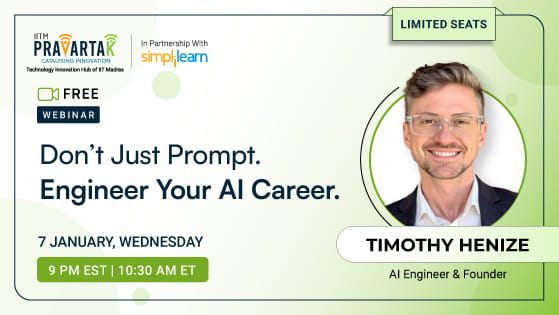
Start Your AI Career in 2026 with Applied Generative AI Program
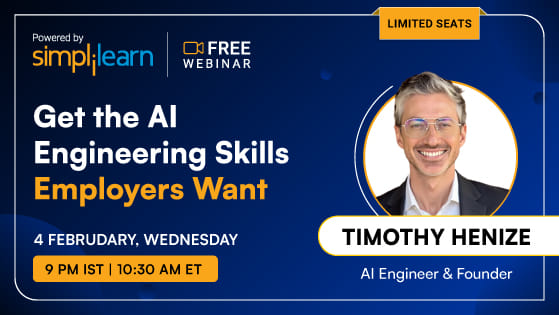
How to Become an AI Engineer in 2026: Your Complete Roadmap

Path to a ₹40+ LPA Salary in AI and ML
Articles and Ebooks That You Can Access For Free

Top Artificial Intelligence Interview Questions

Skilling for the Digital Economy: A Role-Based Approach

Artificial Intelligence and Machine Learning Job Trends in 2026

Unlocking Client Value with GenAI: A Guide for IT Service Leaders to Build Capability












Top Artificial Intelligence Interview Questions
Skilling for the Digital Economy: A Role-Based Approach
Artificial Intelligence and Machine Learning Job Trends in 2026
Unlocking Client Value with GenAI: A Guide for IT Service Leaders to Build Capability
Learners Also Explore






Connect with our learning consultant to get all your questions answered about programs, faculty, and more
Key Things to Know
A working understanding of linear algebra, probability, and calculus is helpful for building and debugging ML models. You do not need a research-level math background to work as a production AI engineer, but comfort with core concepts accelerates your ability to reason about model behavior.