Our AI Courses Duration and Fees

AI Courses typically range from a few weeks to several months, with fees varying based on program and institution.

Program NameDurationFees
Professional Certificate in AI and Machine Learning

Cohort Starts: 16 Dec, 2025

6 months$4,300
Microsoft AI Engineer Program

Cohort Starts: 17 Dec, 2025

6 months$1,999
Machine Learning using Python4 weeks$499

Need help finding your Program

Fill out this form and we will get back to you

AI Courses

Why AI is the Perfect Career Choice for Problem-Solvers and Innovators


Artificial Intelligence (AI) is revolutionizing industries worldwide — from healthcare and finance to education and retail. As organizations increasingly rely on data-driven insights and automation, AI professionals are in high demand. For individuals who enjoy problem-solving, innovation, and working on transformative technology, a career in AI offers both excitement and long-term growth potential.

A career in AI allows you to build intelligent systems, automate processes, and make strategic business decisions using advanced analytics and machine learning. This makes it one of the most future-proof and rewarding domains to enter today.

What Skills and Tools Will You Gain from an AI Course?


An AI course equips you with the essential programming and analytical skills needed to build and manage intelligent systems. Learners are introduced to:

  • Programming Languages: Python, R, and SQL for model development and automation
  • Machine Learning & Data Analytics: Techniques for data preprocessing, model building, and optimization
  • Deep Learning Frameworks: TensorFlow, PyTorch, and Keras for neural network development
  • AI Model Deployment: Tools for real-world implementation and scalability
  • Advanced Specializations: Natural Language Processing (NLP), Computer Vision, and Generative AI applications

These skills enable professionals to design AI systems that solve real-world problems effectively.

Unlock AI: Step-by-Step Learning for All


AI learning is no longer limited to tech experts. Most AI courses are designed for beginners and provide a structured, step-by-step pathway to mastering core AI concepts. Through easy-to-follow modules, learners progress from coding basics and algorithms to building end-to-end AI projects.

Whether you come from a technical or non-technical background, you’ll grasp the fundamentals through interactive exercises and guided examples, making AI both approachable and practical.

From Beginner to AI-Ready: A Learner-Focused Approach


While AI involves mathematical principles like linear algebra, probability, and statistics, modern courses simplify these topics into digestible lessons. You’ll apply theory through hands-on projects, coding labs, and case studies, ensuring you gain both conceptual clarity and real-world experience.

This learner-centric approach transforms complex technical subjects into actionable skills, helping you become job-ready faster.

AI Market Growth & Career Demand


The global AI market is projected to reach hundreds of billions in value by 2030, driven by rapid adoption across industries. Businesses are integrating AI to improve efficiency, personalization, and decision-making — fueling an unprecedented demand for skilled professionals.

Top industries hiring AI talent:

  • Information Technology & Cloud Computing
  • Banking, Financial Services & Insurance (BFSI)
  • Healthcare & Life Sciences
  • Retail & E-commerce
  • Manufacturing & Supply Chain
  • Telecom & Media

In-demand roles include:


AI Engineer, Data Scientist, Machine Learning Engineer, Deep Learning Specialist, NLP Engineer, and Computer Vision Engineer.

The journey often begins with entry-level positions like AI Analyst or ML Associate and can progress toward advanced roles such as AI Architect, Chief Data Officer, or AI Research Scientist.

Can I Actually Make a Good Salary? – Breaking Down Potential Income


AI careers are among the highest-paying jobs globally.

  • Entry-level AI engineers can earn starting salaries of around ₹5–8 LPA (INR 50,000+ per month).
  • Mid-level professionals with 3–5 years of experience earn between ₹12–20 LPA.
  • Senior AI specialists and architects can command salaries exceeding ₹30–40 LPA.

In global markets like the US and UAE, AI engineers can earn between USD 100,000–150,000 annually, depending on expertise and specialization.

How Simplilearn Can Help You Succeed?


Simplilearn offers AI certification programs in partnership with top global institutions such as Purdue University, IITs, and Microsoft, ensuring you gain both credibility and hands-on expertise.

Key Highlights:

  • Blended Learning Model: Live instructor-led sessions, self-paced videos, hands-on labs, and real-world capstone projects
  • Career Services: Resume workshops, interview preparation, and job placement assistance
  • Mentorship & Community: Access to global mentors, industry leaders, and an active learner network

This holistic approach bridges theory with real-world application, preparing you for diverse AI roles across industries.

Career Designations After AI Training Courses

After completing AI training, learners can pursue roles such as:

  • AI Engineer: Builds and deploys AI solutions
  • Machine Learning Engineer: Designs and optimizes learning algorithms
  • Data Scientist: Extracts insights and builds predictive models
  • Deep Learning Specialist: Works on neural network and vision-based projects
  • NLP Engineer: Develops chatbots, voice assistants, and text-processing systems
  • Computer Vision Engineer: Creates AI systems for object recognition, automation, and analytics

These roles exist across domains like healthcare, finance, automotive, and technology — giving you flexibility to choose your area of impact.

Why Choose Simplilearn for AI Courses?

Simplilearn’s AI Courses are built for career transformation. You’ll gain practical exposure through industry-grade projects, case-based learning, and AI-driven simulations.

Why Learners Prefer Simplilearn:

  • Globally recognized certifications backed by prestigious universities
  • Flexible learning paths suited for both working professionals and freshers
  • Expert-led live sessions for conceptual clarity
  • Real-world case studies and projects for hands-on experience
  • Comprehensive career support to make you job-ready

By combining academic excellence, industry relevance, and career mentorship, Simplilearn ensures you graduate with the skills, confidence, and portfolio needed to thrive in the AI job market.

AI Courses FAQS

  • 1. What are AI courses?

    AI courses are comprehensive learning programs focusing on building strong technical skills. These courses focus mostly on core artificial intelligence areas such as machine learning, deep learning, neural networks, and natural language processing. The sole objective of an AI course is to educate students on the unique features of AI technology, advanced tools, and AI practices.

    An AI course also focuses on building generative AI models, mathematics, coding, and a deep understanding of AI algorithms that are used to generate models, give commands to machines, or analyze data and interpret results. 

    In other words, an AI course is a doorway to exploring how this technology serves as the simulation of human intelligence in machines and trains them to act like humans. Signing up for an AI course is also the perfect way to discover the surprising capabilities of this revolutionary technology in detail.

  • 2. Who can enroll in AI courses?

    Individuals who have basic computer knowledge and are keenly interested in exploring artificial intelligence technology can enroll in AI courses of their choice. There are numerous AI courses designed for learners starting from beginners to advanced-level learners. 

    Beginner-level AI courses have very basic prerequisites, such as 10th or 12th-grade degrees with a science background and basic computer skills. However, advanced-level AI courses may require the candidates to acquire STEM or bachelor's degrees with a focus on computer science and related fields. Some advanced courses also require the attendees to have prior programming knowledge.

    Precisely, anyone eager to acquire knowledge in AI technology can enroll in AI courses and hone their skills, but having a computer science background eases up the learning journey.

  • 3. What skills will I learn in an AI course?

    The main focus of an AI course is to hone the skills of a learner; therefore, not just one, there are numerous skills to acquire from these courses. AI courses emphasize mostly on technical concepts and techniques, and the different types of technical skills you can learn are as follows:

    • Machine learning

    • Deep learning

    • Programming 

    • Statistics

    • Data science 

    • Natural language processing

    • Data engineering

    • Data analysis

    • Problem-solving

    • Prompt engineering

    • Generative ai techniques

    • Data warehousing and processing

    • Neural networks 

    • Decision-making 

  • 4. What are the career opportunities after completing an AI course?

    There is an excellent career prospect in the artificial intelligence field after attending an AI course. From the freedom of selecting your career to the generous salary packages and the high-rewarding jobs to look forward to, there are a lot of advantages associated with pursuing AI courses. You can choose from numerous AI-related roles and build a successful career ahead. 

    Here are some of the best AI roles you can fulfill after attending a course:

    Job Roles

    Average Annual Salaries in INR (₹)

    AI Product Manager

    ₹29,00,000

    AI Scientist

    ₹18,00,000

    Data Scientist

    ₹14,15,000

    Artificial Intelligence Engineer

    ₹11,00,000 

    Machine Learning Engineer

    ₹11,00,000

    Natural Language Processing Engineer

    ₹9,00,000

    AI Prompt Engineer 

    ₹6,75,000

    Data Analyst

    ₹6,70,000 

    Robotics Engineer

    ₹5,63,125

  • 5. Are AI courses suitable for beginners?

    There are numerous online courses in AI that are specifically designed for beginners with no or minimal experience in artificial intelligence. For instance, Simplilearn boasts an incredibly long list of beginner-friendly AI courses that can help you start your learning process on the right foot.

    From introductory courses to the ones focusing on core AI concepts, if you are looking for the best AI courses exclusively designed for beginners to begin with, here are the best options for you. 

  • 6. Do AI courses offer certifications?

    Yes, absolutely, if the AI courses are chosen from reputable and accredited online learning platforms like Simplilearn, they are paired with certifications that contribute to career prospects and enhance industry recognition.

    Not only do these certifications make the candidates more job-worthy in the market, but they also become noticeable from the remaining talent pool, becoming a trained and experienced professional ready to face the challenges of real-world professional life in the field of AI.

  • How can I become an AI engineer through the right AI courses?

    You can become an AI engineer by taking structured AI courses that teach topics like Python, machine learning, and deep learning. Online AI courses with projects help you build practical, industry-recognized skills for AI jobs.

  • How to start a career in AI engineering with structured artificial intelligence courses?

    ​​​​​​​A structured artificial intelligence course covers concepts in an organized way, making it easy for beginners to follow. After completing the AI course, you can start your career in AI engineering by applying for in-demand AI roles such as AI engineer, ML engineer, or data scientist.

  • Is AI engineering a high-paying job after completing an AI engineer certification?

    ​​​​​​​Yes, AI engineering is a high-paying career. Certified AI engineers can earn an average annual salary of $120,000–$150,000, with higher pay in specialized AI roles like ML and GenAI engineering.

  • What is the scope of AI courses in India and globally for aspiring engineers?

    ​​​​​​​ AI courses have a high scope in India and globally due to rising GenAI adoption across industries. In India, job postings for AI and data professionals grew 45% between March 2024 and 2025. Globally, AI-skilled workers saw an average 56% wage premium in 2024 and are expected to grow. Therefore, completing AI courses will help aspiring engineers to get into these AI-based roles.

  • Do AI engineers need coding skills to succeed in AI learning courses?

    ​​​​​​​Yes, AI engineers need coding skills to succeed in AI learning courses. Knowledge of Python, R, or Java helps in building and applying machine learning and deep learning models effectively.

  • Can non-technical professionals transition into AI engineering with AI courses online?

    Yes, non-technical professionals can transition into AI engineering with online AI courses. The online AI courses consist of beginner-friendly modules, hands-on training, and industry projects to help non-tech professionals build job-ready AI skills.

  • What is the duration of AI online courses?

    ​​​​​​​The duration of AI online courses depends on the program’s depth and learning format. Learners can choose short-term courses for specific skills or comprehensive programs for in-depth knowledge. Below are some of the AI online courses at Simplilearn:

    Program Name

    Course Duration

    Professional Certificate in AI and Machine Learning

    6 months

    Microsoft AI Engineer Program

    6 months

    Machine Learning using Python

    4 weeks

  • Are online AI courses worth it for beginners and professionals?

    ​​​​​​​Yes. Simplilearn’s online AI courses are suitable for beginners and professionals. Beginners learn foundational AI and machine learning concepts, while professionals can upskill in advanced AI topics, deep learning, and generative AI through hands-on projects.

  • What is the difference between an AI certification online and a degree program?

    ​​​​​​​An AI certification online is a short-term, focused program that teaches practical skills and can be completed in a few months. Whereas a degree program takes 2–4 years and offers a deeper theoretical understanding of AI concepts. At Simplilearn, learners can choose from both short-term courses and certification programs depending on their career goals.

  • Do I need prior experience before enrolling in an AI engineer course?

    ​​​​​​​No. Our AI courses are designed for beginners and experienced learners. Basic programming and mathematical knowledge can be helpful, but the courses begin with foundational concepts and gradually progress to advanced AI techniques.

  • What is an artificial intelligence course?

    An artificial intelligence (AI) course is a structured learning program that teaches you the principles and practical applications of AI. These programs cover how to build intelligent systems that can learn from data, identify patterns, and make decisions. Our AI courses are designed as comprehensive bootcamps that cover foundational concepts like machine learning and deep learning, as well as advanced topics in generative AI, neural networks, and natural language processing (NLP).

    • You will learn the core concepts of AI technology, including the mathematical and statistical foundations.

    • The curriculum is built to provide practical, job-ready skills in advanced tools and AI practices.

    • Courses cover the full AI pipeline, from data analysis and model generation to deploying AI-powered solutions.

  • Why should I choose Simplilearn for an AI course in 2026?

    Simplilearn is a top choice for learning AI in 2026 because our programs are designed as complete digital bootcamps that deliver job-ready skills. We provide a high-touch, outcome-oriented approach that differs from self-paced video platforms. Our model is built on a blended learning pedagogy that combines live online instruction with hands-on labs and 24/7 support, which has resulted in industry-high course completion rates of over 80%. (Source)

    • Live Classes: You will learn in real-time from vetted industry experts who bring current, practical insights into the virtual classroom.

    • University and Industry Partnerships: You will earn credentials co-developed with world-class partners like Purdue University, the Indian Institutes of Technology (IITs), Microsoft, and IBM.

    • Hands-on Projects: The curriculum emphasizes "learning by doing," requiring you to complete numerous real-world projects in integrated lab environments.

    • Career Support: We provide comprehensive career services, including resume reviews, interview preparation, and job assistance to connect your education to a career outcome.

  • Are Simplilearn's AI courses suitable for beginners with no experience?

    Yes, many of our AI courses are designed for beginners and provide a structured, step-by-step path to master core concepts. We understand that learners come from diverse backgrounds, so our programs are built to be approachable even if you do not have a formal computer science degree.

    • Foundational Modules: Programs like the Professional Certificate in AI and Machine Learning start with refresher modules on programming and mathematics to ensure you have the necessary foundation.

    • Structured Learning: The curriculum progresses logically from coding basics and statistical concepts to building and deploying end-to-d end AI projects.

    • Comprehensive Support: Our 24/7 mentoring and support system is designed to help beginners overcome challenges and stay on track.

  • What university-backed AI programs does Simplilearn offer?

    We partner with globally recognized universities to offer co-branded AI programs that provide both academic rigor and practical, job-ready skills. These collaborations mean the curriculum is co-developed, and you benefit from masterclasses delivered by university faculty, ultimately receiving a co-branded certificate that is highly valued by employers.
    • Purdue University: Our Professional Certificate in AI and Machine Learning is offered in collaboration with Purdue University Online, giving you access to Purdue faculty masterclasses and membership in the Purdue Alumni Association.
    • Michigan Engineering: We offer the Michigan Engineering Applied Generative AI Specialization and Michigan Engineering Generative AI Applications for Leaders for those looking to specialize in this high-growth field.

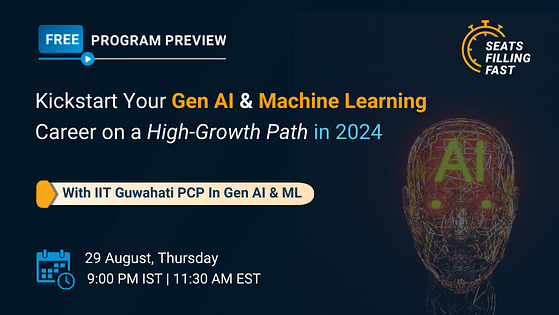
    • Indian Institutes of Technology (IITs): We have partnerships with top-tier institutions like IIT Kanpur and IIT Guwahati for professional certificate programs that feature masterclasses from IIT faculty.
  • What are the best AI courses for different career goals?

    The best AI course is the one that aligns with your specific professional background and career objectives. We offer distinct learning paths for aspiring technical specialists and for business leaders who need to manage AI strategy.

    • For a Technical Career: If your goal is to become an AI Engineer or Machine Learning Engineer, the Professional Certificate in AI and Machine Learning is an ideal choice. It provides a comprehensive, deep dive into Python, deep learning, NLP, and generative AI over a 6-month period.

    • For Generative AI Specialization: To focus on the fastest-growing area of AI, the Applied Generative AI Specialization provides intensive, hands-on training in prompt engineering, LLM frameworks, and building GenAI applications.

    • For Business Leaders: If you are a manager or leader, the Generative AI for Business Transformation or Michigan Engineering Generative AI Applications for Leaders programs are designed for you. They focus on strategy, use cases, and leading AI projects without requiring you to be a coding expert.

    • For a Microsoft-Specific Path: The Microsoft AI Engineer Program is a 6-month learning path designed to prepare you for a career using Microsoft's powerful AI tools and provides in-depth training for the AI-900 certification exam.

  • How do your AI courses differ from traditional Machine Learning programs?

    Our AI courses are comprehensive programs that treat machine learning (ML) as a critical component of a larger ecosystem. While a traditional ML program might focus exclusively on predictive algorithms, our AI programs cover a broader spectrum, including deep learning, neural networks, natural language processing (NLP), computer vision, and the latest in generative and agentic AI.

    • Scope: Traditional ML teaches systems to learn from data to make predictions. Our AI courses include this but also teach how to build systems that can perceive, reason, and create, such as in our deep learning and generative AI modules.

    • Advanced Topics: Our AI curriculum, such as in the Professional Certificate in AI and Machine Learning, goes beyond predictive models to cover transformer architectures, GANs (Generative Adversarial Networks), and building autonomous AI agents.

    • Generative vs. Predictive: We have dedicated courses like the Applied Generative AI Specialization that focus entirely on creation (generating text, images, code) rather than just prediction (forecasting sales or flagging spam).

  • What specific tools and programming languages will I learn in your AI courses?

    You will gain hands-on proficiency in Python, which is the dominant programming language for AI development. Our curriculum is built around the industry-standard tools and frameworks that employers demand, and you will work with them in our integrated lab environments.

    • Programming Language: You will master Python and its key data science libraries like NumPy for numerical computing and Pandas for data manipulation.

    • Machine Learning Libraries: You will learn to build models using Scikit-learn, the industry-standard toolkit for predictive analysis.

    • Deep Learning Frameworks: You will gain extensive experience with TensorFlow and PyTorch, the two leading frameworks for building and training complex neural networks.

    • Generative AI Tools: Our advanced modules and specializations provide hands-on practice with models like OpenAI's GPT-4 and ChatGPT, Google's Gemini, and development frameworks like LangChain and Hugging Face.

    • Cloud Platforms: You will learn to deploy and manage AI solutions on cloud platforms, with programs like the Microsoft AI Engineer Program focusing on Microsoft Azure AI Studio.

  • Do the AI courses include hands-on projects and labs?

    Yes, hands-on application is the core of our learning model. Every AI program we offer is built around learning by doing, ensuring you graduate with a portfolio of work and the practical ability to solve real-world problems. This project-based approach is a key differentiator from purely theoretical or video-based courses.

    • Our Professional Certificate in AI and Machine Learning includes over 15 hands-on projects and multiple capstone projects across different industry domains, such as building a recommendation engine or a loan default predictor.

    • Programs like the Applied Generative AI Specialization require you to tackle more than a dozen projects, such as building an HR chatbot or an AI-powered design tool for marketing.

    • We provide integrated, cloud-based lab environments that are pre-configured with all the necessary tools and datasets, so you can start building immediately.

  • What is Generative AI, and how is it covered in your curriculum?

    Generative AI (GenAI) is a subfield of artificial intelligence that focuses on creating new, original content rather than just analyzing existing data. This includes generating text, images, audio, and code. Given its transformative impact on the industry, GenAI is now a core component of our AI curriculum and is also offered as a dedicated specialization.

    • Dedicated Programs: We offer specialized courses like the Applied Generative AI Specialization and Generative AI for Business Transformation that focus entirely on this topic.

    • Integrated Modules: Our comprehensive programs, like the Professional Certificate in AI and Machine Learning, include dedicated modules on Generative AI. You will learn the theory behind models like GANs and Transformers and get hands-on practice with tools like ChatGPT.

    • Practical Skills: You will learn the most in-demand GenAI skills, including prompt engineering, LLM fine-tuning, and Retrieval-Augmented Generation (RAG).

  • What is Agentic AI, and how do your programs teach this advanced topic?

    Agentic AI, or autonomous AI agents, represents the next frontier of artificial intelligence. These are systems that can plan, reason, and execute complex, multi-step tasks to achieve a goal with minimal human intervention. We have integrated this cutting-edge topic into our advanced AI programs to ensure you are learning the skills that will define the future of the industry.

    • Our Professional Certificate in AI and Machine Learning includes a masterclass on Agentic AI, where you will learn how to design and build AI-driven agents.

    • The Microsoft AI Engineer Program covers agentic AI solutions using tools like AutoGen and Copilot Studio.

    • This is a key part of the "Agentic AI Frontier" identified in market analysis, and our curriculum is designed to place you at the leading edge of this trend.

  • What career opportunities are available after completing an AI certification?

    An AI certification opens the door to a wide array of high-paying, in-demand roles across nearly every industry, including tech, healthcare, finance, and manufacturing. The global AI market is projected to contribute over $15 trillion to the global economy by 2030, fueling massive job growth.

    • AI Engineer

    • Machine Learning Engineer

    • Data Scientist

    • Generative AI Specialist

    • AI Product Manager

    • AI Research Scientist

    • Natural Language Processing (NLP) Engineer

    • AI Solutions Architect

  • How does an AI certification advance my career?

    An AI certification from a program co-developed with partners like Purdue University or Microsoft provides a clear, verifiable signal to employers that you have up-to-date, practical skills. This credential can be a key factor in securing a new job, earning a promotion, or increasing your salary.

    • Validates Your Skills: It provides concrete proof that you have mastered complex topics in AI, machine learning, and generative AI through a structured, hands-on curriculum.

    • Career Transition: A certification provides a clear path for professionals in software development, data analysis, or IT to pivot into high-growth AI roles.

    • Qualifies You for More Jobs: Many companies specifically look for candidates with recognized certifications, as it demonstrates a commitment to continuous learning and a high standard of expertise.

    • Prepares You for Leadership: Our executive-focused programs (like Generative AI Applications for Leaders) are designed to fast-track your path to leadership by teaching you how to manage AI strategy and teams.

  • What is the typical salary range for AI professionals?

    Salaries in artificial intelligence are among the highest in the technology sector, reflecting the specialized skill set and high demand from employers. While exact figures depend on location, experience, and role, certified AI professionals can expect very competitive compensation.

    • PwC's 2025 Global AI Jobs Barometer noted that AI-skilled workers could command a significant wage premium. (Source)

    • In the United States, an AI Engineer can earn an average annual salary of $101,000–$137,000, with senior roles and specializations in generative AI commanding even higher figures. (Source)

    • In India, an AI engineer's salary can range from ₹6,00,000 to ₹8,00,000 for entry-level roles, with mid-level and senior professionals earning well over ₹12,00,000 to ₹18,00,000 annually. (Source)

  • How job-ready will I be after completing a Simplilearn AI course?

    You will be 100% job-ready. Our programs are designed as end-to-end career bootcamps that focus on practical, applicable skills, not just theory. You will graduate with a strong portfolio of real-world projects and the professional polish needed to succeed in interviews and on the job.

    • Portfolio of Projects: You will complete numerous hands-on projects and capstones, such as building AI applications or fine-tuning LLMs, which you can showcase to employers.

    • Career Services: We provide comprehensive career assistance, including expert guidance on your resume and LinkedIn profile, mock interview preparation, and access to job placement assistance to connect you with hiring companies.

    • Industry-Relevant Tools: You will learn the exact tools and frameworks (Python, TensorFlow, Azure, LangChain) that companies are using today.

  • Are payment plans or financing options available for AI courses?

    Yes, we offer several flexible payment options to make our AI programs more affordable and accessible. We are committed to helping you find a way to budget for your education so you can invest in your career.

    • Monthly Installments: You can choose to pay your tuition in monthly installments. We work with financing partners like Klarna and Splitit to help you spread the cost over time, often with low or no interest.

    • Seasonal Discounts: We regularly offer seasonal promotions and special discounts. You should always ask an admissions advisor about any current offers that may be available.

    • Corporate Sponsorship: Many companies are willing to pay for their employees' training. We can provide all the necessary documentation for you to request tuition reimbursement from your employer.

  • Will I have access to the AI course materials after I complete the program?

    Yes, we support your long-term growth and believe in lifelong learning. After you complete your program, you will continue to have access to the learning materials.

    • You will typically receive lifetime access to the self-paced e-learning content, which includes all course videos and digital resources, through our learning platform.

    • This allows you to return to the material at any time to refresh your memory on key concepts or review content for a job interview.

    • You will also be part of our alumni community, a valuable network for professional networking and staying updated on new trends.

  • What does an AI engineer actually do day-to-day?

    An AI engineer is a technical professional who designs, builds, and deploys AI solutions. Their day-to-day work is a blend of software engineering, data science, and model development.

    • Data Preprocessing: They spend a significant amount of time gathering, cleaning, and transforming data so it can be used to train machine learning models.

    • Model Development and Training: They write code (usually in Python) to build machine learning or deep learning models, selecting the right algorithms and frameworks (like TensorFlow or PyTorch) for the task.

    • Testing and Evaluation: They rigorously test models for accuracy, performance, and bias, fine-tuning hyperparameters to achieve the best results.

    • Deployment and Monitoring: They work with software and DevOps teams to integrate the trained AI model into a larger application and deploy it to production, often on a cloud platform like Azure or AWS.

    • Collaboration: They collaborate closely with data scientists, product managers, and business stakeholders to understand requirements and deliver a solution that solves a real business problem.

  • Is AI a good career choice in 2026, or is the market too saturated?

    AI is an outstanding career choice in 2026. The market is far from saturated. In fact, there is a massive and accelerating skills gap. While many people are using AI tools, there is a critical shortage of professionals who can build, deploy, and manage them responsibly.

    • Massive Job Churn: The World Economic Forum projects a "great job churn" of 182 million roles, with 170 million new jobs being created in fields like AI, while 92 million are displaced. This results in a net gain of 78 million jobs, all requiring new skills. (Source)

    • Accelerating Skills Gap: According to PwC's 2025 Global AI Jobs Barometer, skills sought by employers are changing 66% faster in AI-exposed occupations. This means the demand for up-to-date skills is constant, making continuous learning and certification highly valuable. (Source)

    • High Demand: A 2024 McKinsey survey noted a 35% year-over-year change in AI-related job postings, confirming a high and growing demand for talent. (Source)

  • Is AI a good career choice in 2026, or is the market too saturated?

    AI is an outstanding career choice in 2026. The market is far from saturated. In fact, there is a massive and accelerating skills gap. While many people are using AI tools, there is a critical shortage of professionals who can build, deploy, and manage them responsibly.

    • Massive Job Churn: The World Economic Forum projects a "great job churn" of 182 million roles, with 170 million new jobs being created in fields like AI, while 92 million are displaced. This results in a net gain of 78 million jobs, all requiring new skills. (Source)

    • Accelerating Skills Gap: According to PwC's 2025 Global AI Jobs Barometer, skills sought by employers are changing 66% faster in AI-exposed occupations. This means the demand for up-to-date skills is constant, making continuous learning and certification highly valuable. (Source)

    • High Demand: A 2024 McKinsey survey noted a 35% year-over-year change in AI-related job postings, confirming a high and growing demand for talent. (Source)

  • Is artificial intelligence hard to learn?

    Artificial intelligence can be challenging, but it is not unachievable. It is a complex field that combines computer science, mathematics, and data analysis. However, a structured learning program, like our bootcamps, is specifically designed to make it accessible, even for those without an advanced mathematics degree.

    • It Requires Dedication: You will need to learn programming (like Python), key mathematical concepts (like linear algebra and statistics), and complex algorithms.

    • Structured Learning Helps: Our courses break down these complex topics into logical, easy-to-digest modules, starting with fundamentals before moving to advanced applications.

    • Support is Critical: The primary hurdle for self-learners is getting stuck. Our model solves this with 24/7 mentoring and live instructor support, ensuring you can always get help when you need it.

  • Do I need a computer science degree to get a job in AI?

    No, you do not need a traditional computer science degree to get a job in AI, especially for many in-demand roles. While a degree is helpful for deep research (R&D) positions, most corporate AI roles are "applied." Employers are increasingly prioritizing demonstrable skills and hands-on project experience over a specific degree.

    • A high-quality certification, like our Professional Certificate in AI and Machine Learning with Purdue University, provides a powerful and more direct alternative to a multi-year degree program.

    • Your portfolio of projects, which you will build in our courses, serves as tangible proof of your skills.

    • Companies are hiring for what you can do, build a model, deploy an application, fine-tune an LLM, and a certification from a program with hands-on labs is the best way to prove that.

  • What is the best way to prepare for an AI course?

    To get the most out of an AI course, you can take a few simple steps to prepare. While our programs are designed to accommodate beginners, strengthening your foundation in a couple of key areas will help you hit the ground running.

    • Familiarize Yourself with Python: Since Python is the primary language of AI, having a basic understanding of its syntax, data types, and functions will be very helpful.

    • Review Basic Math Concepts: You do not need to be a mathematician, but refreshing your memory on high-school level concepts from linear algebra (vectors, matrices) and statistics (mean, median, standard deviation) will make the course content easier to grasp.

    • Set Up Your Environment: Get comfortable with a code editor like VS Code or a tool like Google Colab, as you will be using these to write and run code.

    • Define Your Goal: Think about why you are taking the course. Do you want to build a specific app? Get a new job? Having a clear objective will keep you motivated.

  • Can I learn AI on my own, or is a structured course better?

    While it is possible to learn AI on your own using free resources, a structured course is a far more efficient and reliable path to a professional career. Self-learning is often isolating and has a very high dropout rate, whereas our structured bootcamps are designed for completion and career outcomes.

    • The Problem with Self-Learning: The biggest challenge is not a lack of information, but a lack of structure, support, and validation. It is easy to get lost, learn outdated information, or get stuck without help, which is why most self-taught learners quit.

    • The Bootcamp Advantage: Our blended learning model provides a clear, step-by-step curriculum co-developed with industry partners. You get live instruction from experts, hands-on labs to practice, and 24/7 support so you are never stuck.

    • Validation: A co-branded certificate from a partner like Purdue or Microsoft provides verifiable proof of your skills, which a self-learning path cannot.

  • What is the real value of an AI certification versus a portfolio of projects?

    This is a common question, but it presents a false choice. The best career outcome results from having both. A portfolio proves you can do the work, while a certification proves your work meets a recognized high standard.

    • A Portfolio Shows What You Can Do: Your projects demonstrate your practical, hands-on ability to build, train, and deploy models. This is essential for technical interviews.

    • A Certification Shows How Well You Can Do It: A certification from a program co-developed with Purdue University or IBM signals to employers that your skills have been validated by a credible, rigorous, and academically respected source. It gets your resume past the first filter.

    • The Best-of-Both: Our programs are designed to provide both. You earn the university-backed certification by building a portfolio of high-quality, hands-on projects.

  • What is the real value of an AI certification versus a portfolio of projects?

    This is a common question, but it presents a false choice. The best career outcome results from having both. A portfolio proves you can do the work, while a certification proves your work meets a recognized high standard.

    • A Portfolio Shows What You Can Do: Your projects demonstrate your practical, hands-on ability to build, train, and deploy models. This is essential for technical interviews.

    • A Certification Shows How Well You Can Do It: A certification from a program co-developed with Purdue University or IBM signals to employers that your skills have been validated by a credible, rigorous, and academically respected source. It gets your resume past the first filter.

    • The Best-of-Both: Our programs are designed to provide both. You earn the university-backed certification by building a portfolio of high-quality, hands-on projects.

  • How long does it take to learn AI and get a job?

    The timeline to become job-ready in AI can vary, but a structured bootcamp is the fastest, most direct route. A typical university degree takes years, and self-learning can be an endless process. Our programs are designed to make you job-ready in a matter of months.

    • Our specialized courses, like the Applied Generative AI Specialization, are 16 weeks long.

    • Our more comprehensive programs, like the Professional Certificate in AI and Machine Learning, typically take 6 months to complete.

    • This focused, intensive learning path allows you to gain the necessary skills, build a portfolio, and start your job search in under a year, which is significantly faster than traditional academic paths.

  • What is the difference between an AI certification and an AI degree program?

    An AI certification and a full degree program serve different purposes and are designed for different career goals.

    • A Degree Program (like a Master's) is academic, theoretical, and research-focused. It takes 2-4 years and is ideal for those who want to become research scientists or pursue a Ph.D.

    • A Professional Certification (like our programs) is applied, practical, and career-focused. It takes 6-12 months and is ideal for professionals who want to get a job as an AI engineer, machine learning engineer, or GenAI specialist.

    • Our programs, especially those partnered with universities like Purdue, offer the best of both worlds: the academic credibility of a university name combined with the speed and practical focus of an industry bootcamp.

  • How does Simplilearn's "blended learning" model work for AI courses?

    Our blended learning model is the core of our pedagogy and a primary reason for our high completion rates. It is a hybrid framework designed to provide the structure and support of a traditional classroom with the flexibility of online learning, directly addressing the low completion rates (often below 4%) of purely self-paced online courses.

    • Live Virtual Classes: You will attend live, instructor-led online classes, where you can interact with industry experts and fellow learners in real-time.

    • Self-Paced E-Learning: You also get lifetime access to high-quality, self-paced video content, which you can use to review concepts or prepare for classes.

    • Hands-On Labs: You will apply what you learn in our integrated labs and hands-on projects, which are the most critical part of the learning process.

    • 24/7 Support: If you get stuck at any time, day or night, you have access to mentors and a support team to resolve your doubts, ensuring you are never left behind.

  • Who are the instructors for Simplilearn's AI programs?

    Our instructors are a key part of our value proposition. We do not use academics who are disconnected from the industry or unvetted content creators. Our instructors are vetted industry practitioners with 10-12 years or more of real-world experience in their field.

    • You will learn from people who are currently working as AI architects, senior data scientists, and ML engineers at top companies.

    • They teach from a practical, hands-on perspective, focusing on the skills that are actually used on the job, not just abstract theory.

    • In our university-partnered programs, this expert instruction is complemented by masterclasses from the university's own faculty, giving you both academic and industry perspectives.

  • How does the Simplilearn job assistance program work?

    Our career services are designed to help you turn your new skills into a tangible career outcome. We provide you with the tools, preparation, and connections to navigate the job market successfully.

    • Resume and LinkedIn Profile: We provide expert review and feedback to help you build a professional resume and LinkedIn profile that are optimized for AI-related job postings.

    • Interview Preparation: You will get access to mock interview tools and coaching to help you confidently answer both technical and behavioral questions.

    • Job Board Access: We provide you with access to job boards and connect you with our network of hiring partners.

  • What kind of support can I expect if I get stuck on a difficult topic?

    Our support system is a cornerstone of our blended model and is designed to ensure you never feel lost or isolated. This is a crucial difference from self-paced MOOCs, where "getting stuck" is the main reason learners drop out.

    • 24/7 Mentoring: You have 24/7 access to a team of teaching assistants and mentors. You can ask questions via chat or email and get a resolution quickly, often in minutes.

    • Live Class Interaction: You can ask questions directly to your instructor during the live virtual classes.

    • Peer Community: You will be part of an active community of fellow learners (often via a dedicated Slack channel) where you can ask questions, collaborate on projects, and share insights.

  • Do I need to be an expert in math and statistics to learn AI?

    No, you do not need to be a math expert. While AI is built on a foundation of mathematics (specifically linear algebra, calculus, and statistics), our applied programs are designed to teach you the concepts you need in a practical context.

    • Applied, Not Theoretical: We do not teach math as an abstract academic subject. Instead, we show you how to use Python libraries like NumPy and Scikit-learn to apply these mathematical concepts to build models.

    • Refresher Modules: Our certificate programs include math and statistics refresher courses to ensure you have a solid grasp of the necessary fundamentals, like mean/median, probability, and vectors.

    • Focus on Application: The goal is to make you an AI engineer, not a mathematician. You need to understand what a concept does (e.g., "gradient descent finds the lowest point of an error-cost 'hill'") more than you need to be able to derive the calculus formula from scratch.

  • What programming language is best for AI, and why is Python so dominant?

    Python is the undisputed, dominant programming language for artificial intelligence, and it is the language we teach in all our AI and ML programs.

    • Vast Ecosystem of Libraries: Python's main advantage is its massive collection of powerful, open-source libraries. Libraries like TensorFlow, PyTorch, Scikit-learn, Pandas, and NumPy provide pre-built tools that make it simple to perform complex AI tasks without writing code from scratch.

    • Simplicity and Readability: Python has a simple, English-like syntax that is relatively easy to learn, read, and maintain. This allows developers to focus on the complex logic of the AI model rather than the complexities of the language.

    • Large Community: Python has a massive and active global community. This means if you have a problem, it is very likely someone else has already solved it and shared the solution online.

    • Flexibility: It is a versatile language that can be used for everything from web development to data analysis and AI, making it easy to integrate AI models into larger applications.

  • What types of hands-on projects will I build in an AI bootcamp?

    The projects in our AI bootcamps are designed to mimic real-world business challenges and build your technical portfolio. You will work on projects across various domains, applying your skills in machine learning, deep learning, and generative AI.

    • Predictive Modeling: You might build a model for a financial institution to predict loan defaults based on customer data or forecast future sales for a retail company.

    • Natural Language Processing (NLP): You could build an AI-powered HR chatbot to answer employee questions or a tool that performs sentiment analysis on customer reviews.

    • Computer Vision: You might work on a project to detect objects in images (like a self-driving car application) or a system to identify diabetic retinopathy from medical scans.

    • Generative AI: In our more advanced courses, you will build generative applications, such as an AI-powered design tool for marketing or an interactive storytelling app using ChatGPT.

  • What is the difference between AI, Machine Learning, Deep Learning, and Generative AI?

    These terms are often used interchangeably, but they represent different, nested concepts. Our programs will help you understand the precise relationship between them.

    • Artificial Intelligence (AI): This is the broadest, most general concept. It refers to any machine or system that mimics human intelligence to perform tasks, such as reasoning, learning, and problem-solving.

    • Machine Learning (ML): This is a subset of AI. ML is the primary method for achieving AI. Instead of being explicitly programmed with rules, an ML system "learns" directly from data to find patterns and make predictions.

    • Deep Learning (DL): This is a more advanced subset of ML. Deep learning uses complex "neural networks" with many layers to solve highly complex problems, such as image recognition or natural language understanding. It is the technology that powers most modern AI.

    • Generative AI (GenAI): This is a subset of Deep Learning. Instead of just predicting a value (like "spam" or "not spam"), generative models are trained to create new, original content, such as writing an email or designing an image.

  • Are there any AI courses that do not require coding?

    Yes, absolutely. We recognize that AI is not just for technical specialists. It is also a critical strategic tool for business leaders. We offer programs specifically designed for managers, executives, and non-technical professionals who need to understand AI from a strategic perspective.

    • The Generative AI for Business Transformation course is designed for leaders and focuses on strategy, ethics, and identifying opportunities, not on writing code.

    • The Michigan Engineering Generative AI Applications for Leaders program is for experienced professionals who need to learn how to design and scale AI strategies effectively.

    • These courses teach you "AI literacy", how to lead AI projects, manage technical teams, and make informed decisions about AI adoption, all without you having to write a single line of Python.

Recommended Resources

Free Masterclass

Free Online Courses

prevNext

Explore other related programs

  • Acknowledgement
  • PMP, PMI, PMBOK, CAPM, PgMP, PfMP, ACP, PBA, RMP, SP, OPM3 and the PMI ATP seal are the registered marks of the Project Management Institute, Inc.