{{ osl_coursePrice}}
{{ lvc_coursePrice}}
{{ cls_coursePrice}}
COURSE PREVIEWView More

View Less
How this works :
At Simplilearn, we greatly value the trust of our patrons. Our courses were designed to deliver an effective learning experience, and have helped over half a million find their professional calling. But if you feel your course is not to your liking, we offer a 7-day money-back guarantee. Just send us a refund request within 7 days of purchase, and we will refund 100% of your payment, no questions asked!
For Instructor Led Training :
Raise refund request within 7 days of commencement of the first batch you are eligible to attend. Money back guarantee is void if the participant has accessed more than 25% content of an e-learning course or has attended Online Classrooms for more than 1 day.
The EC-Council Certified Ethical Hacker course verifies your advanced security skill-sets to thrive in the worldwide information security domain. Many IT departments have made CEH certification a compulsory qualification for security-related posts, making it a go-to certification for security professionals. CEH-certified professionals typically earn 44 percent higher salaries than their non-certified peers.
The ethical hacking certification course opens up numerous career advancement opportunities, preparing you for a role as a computer network defence (CND) analyst, CND infrastructure support, CND incident responder, CND auditor, forensic analyst, intrusion analyst, security manager, and other related high-profile roles.
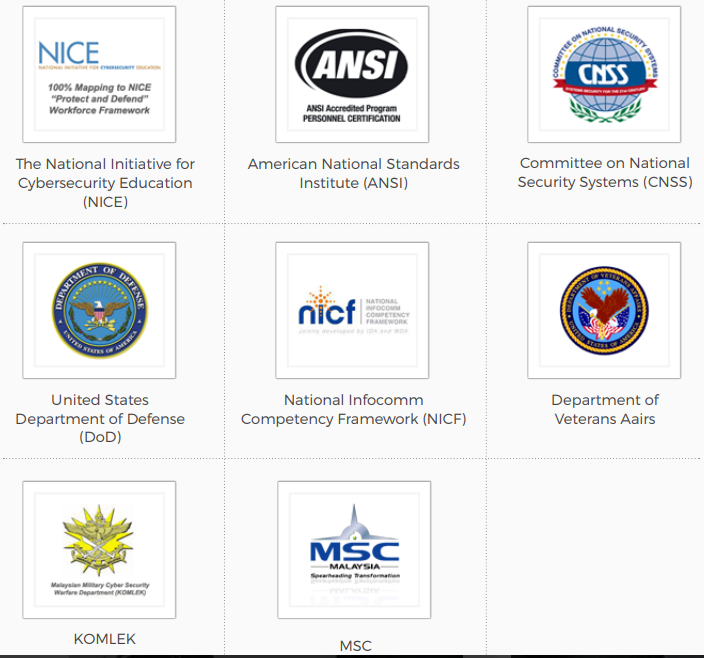
The recognized endorsed bodies of CEH V10 are:
Simplilearn’s CEH v10 Certified Ethical Hacker training (earlier CEH v9) and certification course provide hands-on classroom training to help you master the same techniques that hackers use to penetrate network systems and leverage them ethically to protect your own infrastructure.
This extensive ethical hacking course focuses on 20 of the most popular security domains to provide a practical approach to essential security systems. You will learn to assess computer system security by using penetration testing techniques; scan, test and hack secure systems and applications, and gain hands-on experience with sniffing, phishing and exploitation tactics. This ethical hacking course will prepare you for the EC-Council Certified Ethical Hacker exam 312-50.
In the latest CEH v10 EC-Council has introduced the following changes:
Simplilearn’s Ethical Hacking Course will expand your knowledge of network, web and mobile app security and prepare you to identify threats and vulnerabilities.
This ethical hacking course will help you:
Certified Ethical Hacker (CEH) certification will enhance your ability to assess and analyze computer systems security to protect your corporate infrastructure. The exam code for CEH certification (version 10) is 312-50 and tests your capabilities in using penetration testing tools to evaluate computer systems and network security and implementing the special techniques of ethical hacking.
Upon successfully clearing the CEH® v13 (Certified Ethical Hacker) exam, you receive your official certificate from EC-Council. This certificate signifies your ability to identify vulnerabilities and think like a hacker to strengthen cybersecurity defenses.
The Certified Ethical Hacker (CEH) is a globally recognized, vendor-neutral certification from EC-Council. It validates an IT professional's knowledge and skills in ethical hacking methodologies. The ethical hacking certification proves that an individual can think like a hacker to identify vulnerabilities and weaknesses in target systems and networks, but uses those skills in a lawful, ethical manner to protect assets.
It is a foundational and highly respected credential in the offensive security (or "red team") domain
The certification covers the five phases of ethical hacking, including reconnaissance, vulnerability assessment, and covering tracks, mastering over 550 real-world attack techniques
It is a baseline requirement for many government and Department of Defense (DoD) cybersecurity roles
Tier-1 employers, including the US Army, FBI, Microsoft, and IBM, recognize the ethical hacking certification
This certified ethical hacking course is designed for professionals who need to understand and validate their skills in offensive security and network defense. It caters to a wide range of IT and security personnel, from those in existing security roles to those seeking to enter the field. The program is specifically beneficial for:
IT security professionals and managers
Penetration testers and certified ethical hackers seeking to formalize their skills
Network administrators and security engineers responsible for securing wireless networks and infrastructure
Cybersecurity consultants who advise organizations on security best practices
Incident responders and security analysts
IT auditors, IT operations managers, and application developers
This is an advanced ethical hacking course intended for professionals with a solid background in IT and networking. To be eligible for the program, candidates must meet specific prerequisites.
Educational Background: Learners need to possess an undergraduate degree or a high school diploma
Professional Experience: Learners should have a minimum of two years of IT security experience
Terms Agreement: You must agree to the EC-Council's exam policies and code of ethics
Yes, in 2026 and even beyond, the CEH remains a high-value credential, but its strategic role has evolved. It is no longer an end-state qualification but rather a mandatory foundational framework and a critical clearance mechanism for HR departments.
High Market Demand: Data shows that 92% of hiring managers prefer candidates with a CEH for jobs requiring ethical hacking skills (source)
Regulatory Driver: New compliance mandates, such as SEC rules and the EU's DORA, require companies to prove they are assessing risk, driving massive, compliance-based demand for verifiable certifications like the CEH
Career Transition: It is an exceptionally valuable first step for building a cybersecurity career, with 98% of holders crediting it as crucial to their successful career transition (source)
Foundational Knowledge: It provides the "holistic ethical hacking framework" and "broad theoretical knowledge" that employers value as a baseline
Workplace Recognition: In a 2025 EC-Council report, 100% of high-scoring respondents reported increased respect and recognition at work after attaining the CEH (source)
The Certified Ethical Hacker certification is valid for three years. You must earn 120 EC-Council Continuing Education (ECE) credits to retain your certification, and maintain your annual membership with EC-Council to qualify for recertification.
The CEH exam is a challenging, 4-hour, 125-question multiple-choice test that covers a very broad body of knowledge. Its difficulty comes from its breadth, as it requires you to be familiar with the concepts, tools, and methodologies across all 20 modules.
Knowledge vs. Practice: It is primarily a test of theoretical knowledge, not hands-on application
Comparison: It is not considered "prohibitively difficult" for beginners, unlike the 24-hour, hands-on OSCP exam, which is known for its rigorous practical difficulty
Preparation: Success on the exam depends on comprehensive study of all 20 domains and practical exposure to the tools and techniques, which is why hands-on labs are a key part of training
Completing the CEH certification validates your skills for a wide range of offensive and defensive cybersecurity roles. Hiring managers and government agencies actively seek out CEH-certified professionals for positions that require a proven understanding of attacker methodologies. Some of the key job roles include:
Certified Ethical Hacker
Penetration Tester
Network Security Engineer
Cybersecurity Analyst
Information Security Officer
Data Security Analyst
Computer Forensics Engineer
Security Auditor
Threat Intelligence Analyst
Cloud Security Architect
AI Penetration Tester
This Certified Ethical Hacking Course includes an exam voucher from EC-Council. After you complete your training and unlock your certificate, you can schedule your CEH exam through our Learning Management System (LMS).
The EC-Council governs CEH certification exam prices, which sometimes change. They typically announce price changes at the end of the calendar year. If the price changes while you’re still completing the CEH course, you may need to pay the difference to Simplilearn before booking your exam.
If you want to become a Certified Ethical Hacker, you must pass the CEH exam after completing training with an accredited training partner like Simplilearn or through self-study. Ethical hacking is a highly specialized and challenging area of study, so we recommend that beginners take an in-depth CEH training course to learn the concepts from scratch.
The CEH is a high-value starting point for a career in offensive security. The optimal career path involves "stacking" the CEH with more advanced, practical certifications and high-demand specializations.
Start with CEH: Use the CEH to build the "holistic framework" and satisfy the 92% of hiring managers who look for it. (source)
Add Practical Skills (OSCP): Immediately pursue a practical certification like the OSCP to build hands-on skills. Tier-1 employers like IBM explicitly desire both.
Aim for Specialization: The career-defining salaries are not in general pentesting but in roles like "Cloud Security Architect" or "AI Red Teamer". Use the CEH as a foundation to pivot into these more profitable specializations.
Enrolling in a certified ethical hacker course provides more than just technical knowledge. It shifts your entire professional perspective and helps you learn to anticipate the moves of a malicious actor, the most effective way to defend modern networks.
Career Growth: The CEH consistently ranks among the top-paying IT certifications. In 2026, the average annual salary for certified professionals is around $109,000 (Source: Payscale)
Global Recognition: This ethical hacking certification is accepted worldwide and meets strict standards like the US Department of Defense (DoD) requirements
Skill Validation: The certification validates that your skills meet the latest industry standards for penetration testing and vulnerability assessment
Future-Proofing: With the rise of AI-driven attacks, this course ensures you are updated on the latest defensive strategies
Ethical hackers, also known as white-hat hackers, use their expertise to identify and fix system vulnerabilities, ensuring protection against malicious attacks. Some of the top skills certified ethical hackers should have include:
Phishing detection and prevention
Cyber threat intelligence and response
Cloud security and monitoring
Malware analysis and remediation
Network security and communications protocols
Network traffic analysis, including wireless
Trojan backdoors and related defense strategies, and more…
Today, ethical hackers should also have AI proficiency to enhance all of their skills and strategies.
Becoming a Certified Ethical Hacker opens up many lucrative career opportunities. That being said, choosing the right course is essential to defining your career path. Some factors to consider when selecting your course include:
Course Content: The course should be comprehensive, covering basic concepts to advanced ethical hacking methodologies
Training: Consider seeking a reputable training provider such as Simplilearn for world-class training experience
Instructor Experience: Ensure that instructors possess extensive expertise and official certifications in ethical hacking
Course Quality: Evaluate the quality and efficacy of the course by reviewing feedback from previous students
Cost: When evaluating the price and value of a course, it is essential to compare the fees with the content and benefits you will receive
Simplilearn's Certified Ethical Hacking Course meets all these criteria, providing a complete learning experience.
An ethical hacker is an offensive security professional who identifies and exploits vulnerabilities in computer systems, networks, and software applications to help organizations strengthen their security. They perform penetration testing, vulnerability assessments, and security audits to uncover weaknesses malicious hackers could exploit. By simulating cyberattacks, ethical hackers provide valuable insights and recommendations to help organizations protect sensitive data, ensure compliance with security standards, and prevent unauthorized access.
All learners will receive an industry-recognized completion certificate from Simplilearn upon completing the CEH certification training. This training prepares for the EC-Council exam, upon passing which, you will receive the official Certified Ethical Hacker (C|EH) v13 credential.
We offer around-the-clock assistance to ensure your learning never hits a roadblock. Our support system is built to help you every step of the way:
|
Support Channel |
Service Provided |
|
Email, Chat & Phone |
24/7 access to learner support specialists to resolve technical issues or answer program questions. |
|
Community Forum |
On-demand assistance from a dedicated team and peers to discuss course concepts and projects. |
|
Lifetime Access |
Continued access to the community forum even after you complete your ethical hacking training. |
We strive to ensure that our users have a rewarding learning experience, whether instructor-led or self-paced. If necessary, you can cancel your enrollment. For more information, please read our refund policy.
Yes, Simplilearn offers several online cybersecurity courses. These include specialized certification training (like the Certified Ethical Hacker Course), master's programs, and professional certificate programs tailored to different skill levels.
Similar cybersecurity courses we offer include, but aren’t limited to:
Our ethical hacking course follows a blended learning model that combines theory with heavy practical application. The structure ensures you move from basic concepts to advanced exploitation in a logical sequence:
Core Learning: Live, instructor-led virtual classes with self-paced videos from industry experts
Applied Labs: Access to EC-Council's official CEH v13 AI Labs for six months, featuring over 220 hands-on exercises in a cloud-based cyber range
Real-World Scenarios: Working through actual hacking cases to build problem-solving skills
Exam Readiness: Official study materials from EC-Council, including mock tests and quizzes
The Exam Pass Guarantee is a feature of this accredited training program and our commitment to your success. If you complete the course requirements, including attending classes and finishing the labs, but do not clear the CEH exam on your first attempt, we will provide you with a free exam retake.
This guarantee is designed to help learners achieve their certification goals.
Simplilearn's CEH v13 training program provides extensive hands-on experience with over 4,000 integrated hacking and security tools within the official CEH v13 AI Labs. The tools covered span all 20 domains and cover topics, such as:
Reconnaissance: Use Nmap and advanced Google hacking techniques for footprinting and investigating social networking sites
Exploitation Frameworks: Learn Metasploit and various privilege escalation tools to test system defenses
Web Application Tools: Leverage Burp Suite and sqlmap for web server attacks and application auditing
Password Crackers: Practice with industry standards like John the Ripper and THC-Hydra
Packet Sniffers: Utilize Wireshark and learn techniques to evade intrusion detection tools
Wireless Hacking Tools: Execute complete wireless methodologies using Aircrack-ng
Mobile Security: Implement mobile security guidelines using specialized Android security tools
The v13 update is a major shift because it integrates Artificial Intelligence into the core of the ethical hacking certification. You will learn how AI is changing the way we attack and defend systems:
AI-Driven Reconnaissance: Using AI to automate the gathering of data and identify targets faster than ever
Automated Exploit Generation: Understanding how attackers use machine learning to create custom malware that bypasses traditional firewalls
Defensive AI: Learning how to deploy AI models that can spot and stop automated hacking attempts in real-time
Prompt Injection Attacks: Mastering the security of Large Language Models (LLMs) and how to prevent malicious prompts from compromising AI applications
This program focuses heavily on applied learning and offers over 220 hours of hands-on exercises and 150 practice demos. You will spend the majority of your time in the official CEH v13 AI Labs, which offer a safe, virtual environment to test your skills.
Advanced Toolset: You get to work with the exact software used by professionals, from Nmap to Metasploit,
Extensive Labs: These labs cover all 20 security domains, allowing you to practice everything from cloud hacking to mobile security
Real-World Scenarios: The training includes over 550 real-world attack techniques, including specific labs for hacking web servers, analyzing Linux machine logs, and methods to hide data on Linux machines
Our program is an end-to-end solution for certification. As an accredited EC-Council training partner, we provide a structured learning path that focuses solely on the official exam objectives.
Official vouchers covering both the CEH v13 theory exam voucher and the practical exam voucher
Exam Pass Guarantee with A free retake for both the theory and practical exams, offering assurance and flexibility
Expert lessons from certified industry instructors with 8x higher interaction in live online classes
220+ practical labs directly aligned with the exam to build practical muscle memory
Access to the latest study resources from EC-Council to supplement your learning
While the terms are often used interchangeably, there is a subtle distinction. "Ethical Hacker" is a broad term for a security professional who uses hacking skills for defensive purposes, while "Penetration Tester" (or "pen tester") refers to a specific job role focused on performing authorized security tests.
CEH (The Certification): This is a credential that validates your knowledge across a wide range of ethical hacking topics. It proves you understand the methodologies.
Penetration Tester (The Job): This is a specialized role where you are actively hired to use vulnerability assessment tools and conduct simulated attacks against a specific scope to find weaknesses.
Career Path: The CEH certification is a common requirement for landing a job as a penetration tester.
In 2026, new and strict regulations, such as the SEC cybersecurity rules and the EU's Digital Operational Resilience Act (DORA), have transformed ethical hacking. It is no longer just a technical "best practice" but a board-level legal and financial requirement.
A Certified Ethical Hacker (CEH) plays a critical role in helping organizations meet these mandates:
The SEC's rules require public companies to disclose their processes for managing "material risks" from cyber threats. A CEH provides the technical proof that these risks are being actively managed.
The most legally defensible way for a company board to prove it has a strong security process is to conduct and document simulated attacks. CEHs conduct these penetration tests to identify and fix gaps before they result in a legal breach.
Ethical hacking is now a legal "must-have" for every organization, and this shift has created a massive demand for certified cyber professionals.
While both are highly respected, they focus on different aspects of security and use different testing methods.
|
Feature |
CEH (Certified Ethical Hacker) |
OSCP (Offensive Security Certified Professional) |
|
Focus |
Comprehensive knowledge of hacking phases, tools, and diverse domains (Cloud, IoT, AI). |
Purely technical, hands-on penetration testing and exploit development. |
|
Exam Style |
125 Multiple-choice questions (Theory) + Optional Practical lab. |
24-hour strictly practical "hands-on" exam. |
|
Skill Level |
Great for beginners to intermediate professionals and widely recognized by HRs and the government. |
Intermediate to advanced and highly prized by technical teams for "hardcore" red-teaming. |
|
Methodology |
Focuses on the 5 phases of hacking and tool proficiency. |
Focuses on the "Try Harder" mindset and manual exploitation without heavy reliance on automated tools. |
CEH and CISSP (Certified Information Systems Security Professional) are both prominent cybersecurity certifications, but they target different career paths and skill sets. CEH is a technical, offensive certification, while CISSP is a managerial, defensive certification.
CEH (The "Hacker"): Focuses on the "how" of an attack. It is for the technical professional (like a penetration tester or red teamer) who performs simulated attacks and understands vulnerabilities from an attacker's perspective.
CISSP (The "Manager"): This certification is for security leaders, managers, or architects. It focuses on the "why" of security, designing and overseeing an organization's entire security program, including policy, risk management, and compliance.
Offerings: We offer separate, dedicated training programs for both certifications, recognizing their distinct career tracks.
The CompTIA Security+ and CEH certifications target different levels of expertise. The CEH course has a prerequisite of a minimum of two years of IT security experience, positioning it as a certification that builds on existing knowledge.
Security+ (Foundational): Security+, which we offer as a foundational program, is generally considered a starting point for a cybersecurity career.
CEH (Specialization): The CEH program is designed to build on existing security knowledge to specialize in offensive techniques. This is reflected in its prerequisite of two years of IT security experience.
Career Path: A common path is to use a foundational certification to gain experience, then pursue the CEH to specialize in ethical hacking.
The "CEH Master" designation is a more advanced recognition from EC-Council. You earn this designation by successfully passing both the CEH v13 knowledge-based (theory) exam and the separate, hands-on CEH Practical exam. This demonstrates that you possess both the theoretical knowledge and the practical, real-world skills of an ethical hacker.
The Certified Ethical Hacker certification is valid for three years. To maintain your certification, you must participate in the EC-Council Continuing Education (ECE) program.
Credit Requirement: You must earn 120 ECE credits within your three-year certification cycle
Annual Membership: You must also maintain your annual membership with EC-Council to qualify for recertification
Purpose: This process ensures that certified professionals stay current with the rapidly evolving cybersecurity threat landscape
The rapid emergence of Generative AI (GenAI) has fundamentally altered the ethical hacker's role, creating both a new, complex attack surface and a new class of professional tools. This has bifurcated the professional's job.
Attacking AI: Certified Ethical hackers must now be capable of attacking AI models themselves, testing for new vulnerabilities like those in the OWASP GenAI Top 10.
Using AI: They must also use AI-driven tools to maintain efficiency and counter AI-powered defenses. AI is being integrated into pentesting to automate routine tasks like reconnaissance and documentation.
AI as a Threat: Adversaries are using AI to scale phishing (with a 1265% increase reported), automate intrusions, and lower the skill barrier for creating malware. In 2026, a certified ethical hacker must be able to simulate and defend against these AI-powered attacks. (source)
Curriculum Update: The CEH v13 curriculum has been updated to include these new AI-powered techniques to keep professionals current.
The "explosion in the use of generative AI has expanded the attack surface" and requires "new security testing methods". The new gold standard for this is the OWASP GenAI Top 10, which provides a new "checklist" for AI security auditors.
LLM01: Prompt Injection: Manipulating the LLM's instructions via user input to bypass safety controls
LLM02: Sensitive Information Disclosure: Tricking the model into leaking its training data, PII, or proprietary algorithms
LLM04: Data and Model Poisoning: Attacking the model's training data to create hidden backdoors or biases
LLM06: Excessive Agency: Assessing if the LLM has been granted dangerous, high-level permissions to interact with other systems or APIs
LLM08: Vector and Embedding Weaknesses: Attacking the Retrieval-Augmented Generation (RAG) knowledge base
Cloud penetration testing is the #1 specialization for certified ethical hackers, driven by the "relentless growth in cloud adoption". This is confirmed by Mandiant's 2025 M-Trends report, which finds that "Cloud & SaaS are 'the norm'" for modern intrusions. The CEH v13 curriculum includes a dedicated module on cloud computing to address this. (source)
New Vulnerabilities: This domain requires a new skillset, as the most common cloud flaws are not traditional network bugs. The top vulnerabilities are:
Misconfigured Cloud Storage
Weak Authentication Mechanisms
Insecure APIs
Identity and Access Management (IAM) flaws
New Rules: The "Shared Responsibility Model" redefines the scope of a cloud-based ethical hack. Testers are forbidden from attacking the provider's infrastructure (e.g., Microsoft Azure's hardware); they may only test their own applications and configurations running on the cloud.
While tools are important, a senior-level candidate in 2026 is expected to be a "stack" of three complementary skills, as evidenced by hiring criteria from Tier-1 employers like IBM.
Frameworks: Proficiency in methodologies like OWASP, NIST, and PTES. This is the theoretical knowledge validated by the CEH.
Practical Skills: Hands-on ability with tools like Burp Suite and Metasploit. This is the skill validated by the OSCP.
Automation: Experience with scripting languages (e.g., Python, Bash, PowerShell) to automate tasks or develop custom exploits. This is a critical, non-negotiable bridge between theory and practice for senior roles.
Documentation: A key skill for a Certifiedethical hacker is reporting and documentation to clearly communicate findings and recommendations to stakeholders.
Yes, Simplilearn offers certification and skills-training programmes that are designed to align with employer tuition assistance/tuition reimbursement initiatives in the US. Many of our learners receive full or partial financial backing from their organisations.
Simplilearn offers a variety of master’s, post-graduate, and certification courses that one can pursue after completing the Cyber Security Expert Course. You can further enhance your skills with post-graduate programs and advanced certification training courses that dive deeper into specialized areas of cybersecurity. These targeted courses focused on mastering key tools and technologies within Cyber Security are designed to build on your existing knowledge and help you stay ahead of the competition.
Here are some of the Key Cyber Security Courses we offer:
The instructor chains together the learning topics very well. One subject leads to the next, and they are woven together comprehensively.
I chose to upskill in cybersecurity to pursue a career shift and specialize in ethical hacking and cybersecurity. The course allowed me to successfully transition into cybersecurity, equipping me with invaluable skills for my growth in this field.
Simplilearn's Certified Ethical Hacking course, I would like refer my friend for the same course.
Simplilearn is one of the best online platform for ethical hacking course. I had enrolled for CEHV10 - Certified Ethical Hacker Training certification. The course was simple and easy to understand. Overall it was very good. I would recommend it strongly for professional enhancement.
Read more Read lessSimplilearn is the best platform for you if you wish to enter the CEH environment and practice on different tools. Thanks a lot to my trainer, Mr. Bharat & Simplilearn Team!
The course encapsulates the offensive approach, which is good, and there is much to learn.
It was really a fantastic program.
The course was very nice, learned many new things. The tutor was nice and useful.
Experienced faculty and excellent facility to make learning enjoyable and enrich.
The training module is been very well structured and delivered. Trainer has been practical working in real time and helped me to get more information on real time security information. Overall feedback, Very Good.
Mr.Pompilio has been an IT Professional since 1989. He has worn many hats along the way and holds over 20 IT certifications which include EC-Council CEI, CEH, CHFI, CISSP, CISA, CISM. His passion is to help IT professionals achieve their training goals and career growth.
Bipin has 17+ years of experience in architecting physical and cloud infrastructure deployments and security. As an EC-Council board member he is responsible for verifying CEH and ECSA courses. He is a Cloud security expert across public and private domains.

A Simplilearn representative will get back to you in one business day.