Cloud Architect Masters Program

Master AWS, Azure and Google Cloud with our Cloud Architect Course

Get access to an MS Azure exam voucher for any one Azure course

Get access to an MS Azure exam voucher for any one Azure course   

Earn a course completion badge/certificate on the MS Learn portal

Earn a course completion badge/certificate on the MS Learn portal   

Get access to AWS authorized self learning content

Get access to AWS authorized self learning content

Earn an official Microsoft course completion transcript, validating your successful program completion

Earn an official Microsoft course completion transcript, validating your successful program completion

Learn 40+ In-Demand Skills & 25+ Services

Learn 40+ In-Demand Skills & 25+ Services

Get lifetime access to self-paced videos & class recordings

Get lifetime access to self-paced videos & class recordings

Get access to global teaching assistance

Get access to global teaching assistance

Get hands-on with tools like AWS Lambda, Azure Container Services, AWS IAM, Amazon Inspector, Azure Block Bob & many more

Get hands-on with tools like AWS Lambda, Azure Container Services, AWS IAM, Amazon Inspector, Azure Block Bob & many more  

Content aligned to AWS SAA-C03 exam

Content aligned to AWS SAA-C03 exam

Learning path A curated learning path by our experts for you

Course 1

AWS Solutions Architect Online Classroom Flexi Pass SHOW CLASSES

The AWS certification training course is designed to help you gain an in-depth understanding of Amazon Web Services (AWS) architectural principles and services such ...Know More Less
Course Content

Accreditation with AWS

Loading...
    • {{childObj.title}}
      • {{childObj.childSection.chapter_name}}
        • {{lesson.title}}
      • {{lesson.title}}

    View More

    View Less

GO TO COURSE PAGE
Class schedule All Batches
  • May 23 - Jun 21 Weekend classes 08:30 - 12:30 CDT 10 sessions
    • May
    • Sat23
    • Sun24
    • Sat30
    • Sun31
    • Jun
    • Sat06
    • Sun07
    • Sat13
    • Sun14
    • Sat20
    • Sun21
  • Jun 02 - Jul 03 Weekday classes 10:30 - 12:30 CDT 20 sessions
    • Jun
    • Tue02
    • Wed03
    • Thu04
    • Fri05
    • Tue09
    • Wed10
    • Thu11
    • Fri12
    • Tue16
    • Wed17
    • Thu18
    • Fri19
    • Tue23
    • Wed24
    • Thu25
    • Fri26
    • Tue30
    • Jul
    • Wed01
    • Thu02
    • Fri03
  • Jun 26 - Jul 25 Weekday classes 22:30 - 02:30 CDT 10 sessions
    • Jun
    • Fri26
    • Sat27
    • Jul
    • Fri03
    • Sat04
    • Fri10
    • Sat11
    • Fri17
    • Sat18
    • Fri24
    • Sat25

Download schedule

Course 2

Microsoft Azure Fundamentals Self Paced Learning

Simplilearn’s Microsoft Azure Fundamentals Training Course will familiarize you with the main principles of cloud computing and how they have been implemented in M ...Know More Less
Course Content
Loading...
    • {{childObj.title}}
      • {{childObj.childSection.chapter_name}}
        • {{lesson.title}}
      • {{lesson.title}}

    View More

    View Less

GO TO COURSE PAGE
Course 3

Microsoft Certified: Azure Administrator Associate AZ:104 Online Classroom Flexi Pass SHOW CLASSES

Become a part of the Azure revolution with our Microsoft Certified Azure Administrator Associate training course. Aligned with the 2020 edition of Exam AZ-104 Micros ...Know More Less
Course Content

Accreditation with Microsoft

Loading...
    • {{childObj.title}}
      • {{childObj.childSection.chapter_name}}
        • {{lesson.title}}
      • {{lesson.title}}

    View More

    View Less

GO TO COURSE PAGE
Class schedule All Batches
  • May 01 - May 30 Weekday classes 22:30 - 02:30 CDT 10 sessions
    • May
    • Fri01
    • Sat02
    • Fri08
    • Sat09
    • Fri15
    • Sat16
    • Fri22
    • Sat23
    • Fri29
    • Sat30
  • Jun 20 - Jul 19 Weekend classes 08:30 - 12:30 CDT 10 sessions
    • Jun
    • Sat20
    • Sun21
    • Sat27
    • Sun28
    • Jul
    • Sat04
    • Sun05
    • Sat11
    • Sun12
    • Sat18
    • Sun19
  • Jul 03 - Aug 01 Weekday classes 22:30 - 02:30 CDT 10 sessions
    • Jul
    • Fri03
    • Sat04
    • Fri10
    • Sat11
    • Fri17
    • Sat18
    • Fri24
    • Sat25
    • Fri31
    • Aug
    • Sat01

Download schedule

Course 4

Designing Microsoft Azure Infrastructure Solutions AZ-305 Self Paced Learning

This Microsoft Azure Architect Design certification training establishes you as an expert Azure Solutions Architect and helps you ace the AZ-305 exam. You will learn ...Know More Less
Course Content

Microsoft Azure

Loading...
    • {{childObj.title}}
      • {{childObj.childSection.chapter_name}}
        • {{lesson.title}}
      • {{lesson.title}}

    View More

    View Less

GO TO COURSE PAGE
Course 5

Cloud Architect Capstone Project Online Classroom Flexi Pass SHOW CLASSES

Cloud Architect Capstone Project

Course Content
Loading...
    • {{childObj.title}}
      • {{childObj.childSection.chapter_name}}
        • {{lesson.title}}
      • {{lesson.title}}

    View More

    View Less

GO TO COURSE PAGE
Class schedule All Batches
  • Jul 18 - Jul 19 Weekend classes 08:30 - 12:30 CDT 2 sessions
    • Jul
    • Sat18
    • Sun19

Download schedule

Master’s Certificate *You will get individual certificates for each course.
Electives
  • Mastering AWS Services: Official AWS Content
  • Exposure to Cloud Applications on Google Cloud
  • AWS SysOps Associate
  • AWS Developer Associate
  • Microsoft Certified Azure Developer Associate: AZ:204
  • AWS Database Migration
  • AWS Cloud Technical Essentials
DOWNLOAD SYLLABUS

Request more information

We are looking into your query.
Our consultants will get in touch with you soon.
  • What benefits do learners receive through Simplilearn’s collaboration with Microsoft Azure?

    Upon completing the Microsoft Azure courses at Simplilearn, learners will gain the following advantages:

    • They'll earn an official course completion badge/certificate on the Microsoft Learn portal.

    • Students can obtain an official Microsoft course completion transcript, validating their successful program completion.

  • What are the Cloud Architect course objectives?

    The cloud architect certification program is designed to help you become an expert in cloud computing architecture. It will enable you to master the core skill sets required for designing and deploying dynamically scalable, highly available, fault-tolerant, and reliable applications on three top cloud platform providers — Amazon Web Services (AWS), Microsoft Azure, and Google Cloud Platform. The program will give you an in-depth understanding of cloud computing solutions such as AWS CloudFormation, Azure Resource Manager, AWS EC2, AWS S3, AWS Route 53, Azure App Services, GCP, and more. You’ll acquire the knowledge and skills to successfully acquire in-demand Cloud Architect certifications such as AWS Architect and Azure Architect.

  • Why become a Cloud Architect?

    With the increasing focus on cloud computing and infrastructure over the last several years, cloud architects are in high demand worldwide. Many organizations have moved to cloud platforms for better scalability, mobility, and security, and cloud solutions architects are among the highest-paid professionals in the IT industry.

    Becoming a certified solutions architect or cloud architect is a highly desirable goal for those seeking to fast-track their careers in cloud computing. With the number of cloud solutions architect opportunities on the rise, the following roles will benefit from this learning path:

    • Product managers

    • Systems administrators and IT managers

    • IT administrators and operators

    • IT engineers

    • Cloud engineers

    • Software developers

    • Software architects

    Read more: How to Become a Cloud Architect

  • What projects are included in this Cloud Architect course?

    This Cloud Architect Certification program includes real-world, industry-based projects on different domains to help you master the concepts of Cloud Architecture. Sample projects include:

    Project 1: Setting up a WordPress blog for your organization using defined specifications with Amazon Cloudformation, AMI and Autoscaling

    Project 2:  Linux instance for testing new applications using EC

    Project 3: Content Distribution using S3, Cloudfront, Geo restriction and logging

    Project 4: Hosting Web Applications and Performance Monitoring

    Project 5: Provision Dev Environment & Secure Azure Web Applications

    Project 6:  Create two Amazon S3 Buckets

  • What is the difference between a DevOps role and Cloud Architect (AWS)?

    A Cloud Architect guides stakeholders and translates business requirements into scalable, secure, and reliable cloud solutions. They are experts in designing and implementing solutions on cloud platforms. On the other hand, a cloud DevOps professional has expertise in working with people, technologies, tools and processes that enable businesses to implement automation solutions on the cloud.

  • What job roles does this Cloud Architect certification prepare me for?

    Completing this master's program makes you a strong candidate for several of the most in-demand and well-compensated roles in the cloud computing industry.

    • Solutions Architect
    • Cloud Architect
    • Network Architect
    • Software Architect
    • Cloud Engineer
    • Cloud Consultant
    • Cloud Administrator

  • Does the Simplilearn cloud architect certification expire?

    The Cloud Architect Masters Program completion certificate you earn from us does not expire. However, it is very important to remember that the official industry certifications this program prepares you for (like those from AWS and Microsoft) do expire. These typically need to be renewed every two to three years to remain active.

  • Does this program prepare for official cloud certifications?

    Yes, a primary goal of this program is to prepare you to pass several of the most valuable, industry-recognized cloud certifications from both AWS and Microsoft.

    • AWS Certified Solutions Architect Associate (SAA-C03)
    • Microsoft Azure Fundamentals (AZ-900)
    • Microsoft Certified: Azure Administrator Associate (AZ-104)
    • Microsoft Certified: Azure Solutions Architect Expert (AZ-305)

  • What are the prerequisites for enrolling in this cloud architect course?

    The program is designed to be accessible to a wide range of professionals, and the eligibility criteria are straightforward.

    • Age and Education: You must be at least 18 years old and have a high school diploma or an equivalent qualification
    • Experience: There is no requirement for prior professional work experience to enroll in the program
    • Helpful Background: While not a mandatory prerequisite, a basic idea of Azure administration, development, or DevOps is preferred and will be beneficial
VIEW MORE
  • What is the Simplilearn Cloud Architect Masters Program?

    This 4-month online program builds expertise in multi-cloud architecture, specifically focusing on Amazon Web Services (AWS), Microsoft Azure, and Google Cloud Platform (GCP). It’s a structured learning path that guides you from foundational concepts to advanced design and deployment, preparing you for top industry certifications and roles.

    • The curriculum is designed to help learners master the skills needed to design, deploy, and manage scalable, reliable applications on the cloud
    • It follows a defined sequence of courses, beginning with fundamentals and moving to advanced architecture, all culminating in a capstone project
    • The course content is aligned with the official curriculum of both Amazon Web Services and Microsoft Azure

  • What does a cloud architect do on a day-to-day basis?

    A cloud architect is the professional responsible for designing, building, and managing an organization's cloud computing infrastructure and strategy. Their daily work is a mix of high-level design, technical collaboration, and strategic planning to ensure the cloud environment meets business needs securely and cost-effectively.

    • Design and Planning: They create the high-level "blueprints" for cloud solutions, selecting the right services from providers like AWS or Azure to solve a specific business problem.
    • Governance and Security: A huge part of their job is defining security policies and "guardrails". This includes managing Identity and Access Management (IAM), configuring network security, and making sure the infrastructure is compliant with regulations.
    • Collaboration: They are a key link between different teams. They work with developers to create automated "golden paths" for deploying applications, with finance to manage costs (FinOps), and with business leaders to align on strategy.
    • Automation: Modern architects don't just "click" in a console. They write Infrastructure as Code (IaC) using tools like Terraform or CloudFormation to automate the creation and management of infrastructure, making it repeatable and less prone to error.
    • Evaluation and Innovation: They spend time evaluating new cloud services, such as AI platforms or vector databases, to see how these new tools can be used to create value or solve new business challenges.

  • How long is a cloud architect certification valid?

    There are several types and levels of cloud architect certifications, so the duration of their validity also vary. A cloud architect certification is typically valid for two to three years. To keep certifications up-to-date, they must take recertification exams designated by the respective organizations. Gaining recertification also helps keep cloud professionals updated on the latest trends, technologies and techniques.

  • What qualifications does a cloud architect need?

    To become a certified cloud architect, you must have a solid knowledge of cloud technologies and platforms. You must demonstrate the ability to build and manage cloud infrastructure effectively. It is also essential to have working knowledge of programming languages, operating systems, networking, and security.

  • What is the average salary for a cloud architect?

    Salaries for cloud architects are consistently high, though the final figure depends on your location, years of experience, and the company.

    • U.S. Average: Glassdoor reports the average annual salary for a cloud computing professional in the United States is around $148,000. (Source)
    • Entry-Level (0-2 years): Salary guides for 2025 show that architects just starting can expect to earn between $89,000 and $180,000. (Source)
    • Mid-Level (4-6 years): With a few years of experience, the typical range increases to $163,000–$252,000. (Source)
    • Senior-Level (5+ years): Senior architects with deep experience often earn between $166,000 and $248,000. Those with in-demand specializations like AI or FinOps can command salaries that are even higher. (Source)

  • Does Simplilearn provide practice exams related to this Cloud Architect Course?

    Yes, we provide a practice test as part of our cloud architect program to help you prepare for the actual certification exam. You can try this free Cloud Architect Free Practice Test to understand the type of questions that you would encounter in the actual exam. Other free practice exams include:

  • Who are the instructors for this cloud architect course and how were they selected?

    The trainers for this cloud architect course are industry experts with years of practical experience. Before they are qualified to train for us, they must undergo a thorough selection procedure, including profile assessment, technical examination, and a training presentation.

  • What are the eligibility criteria to enroll in this cloud architect course?

    To be eligible for this Cloud Architect course, applicants should have a bachelor's degree in a relevant field. Simplilearn’s Cloud Architect course can be taken up by newcomers and experienced professionals. Though prior knowledge of cloud computing is helpful, it is not compulsory. Additionally, there is no requirement for previous work experience.

  • Are there any other online courses Simplilearn offers under cloud architect?

    Simplilearn offers a variety of master’s, post-graduate, and certification courses that one can pursue after completing cloud architect course. You can further enhance your skills with post-graduate programs and advanced certification training courses that dive deeper into specialized areas of cloud computing. These targeted courses focused on mastering key tools and technologies within cloud computing are designed to build on your existing knowledge and help you stay ahead of the competition.

    Similar programs that we offer under cloud computing:

  • What kind of support do learners receive?

    The program includes 24/7 support to help you with questions or technical challenges whenever they arise.

    • Multiple Channels: You can get help through email, live chat, or over the phone
    • Peer Learning: You will get access to community forums, which are a great place to interact with peers and industry experts
    • Expert Guidance: The program also provides access to global teaching assistants who can guide you and help you resolve your doubts

  • What is the refund policy for this cloud architect course?

    Please read our refund policy for information about cancellations and refunds regarding our cloud architect course. Alternatively, you can contact us by email, telephone, or live chat if you need any assistance.

  • What is the review of Simplilearn’s cloud architect course?

    Simplilearn continually receives positive reviews from its alumni for its cloud architect course. Learners praise its practical, hands-on approach, industry-aligned curriculum, and expert instructors. Many users highlight the value of the globally recognized certificates and the flexible learning options that suit working professionals. You can check out the Simplilearn alumni review page to get a better understanding of Simplilearn’s cloud architect.

  • Can I still complete the program if I miss a live class?

    Yes, you can absolutely complete the program even if you miss a live class. The program is designed with a "flexi-learn" feature to accommodate the busy schedules of working professionals.

    • All live, instructor-led sessions are recorded and added to the learning platform.
    • You can watch the recording at any time that is convenient for you. Watching the recording will also mark your attendance for that class, so you won't fall behind.

  • *For which countries is the Azure exam voucher included in the program?

    Exam vouchers are exclusively available for purchases made from and intended for use within the Republic of India or the United States of America only.

  • Does Simplilearn have corporate training solutions?

    Yes, Simplilearn for Business offers learning solutions for the latest AI and other digital skills, including industry certifications. For talent development strategy, we work with Fortune 500 and mid-sized companies with short skill-based certification training and role-based learning paths. We also offer a learning library with unlimited live and interactive solutions - Simplilearn Learning Hub+, which is accessible to your entire workforce. Our team of curriculum consultants works with each client to select and deploy the learning solutions that best meet their teams’ requirements.

  • Who is this Cloud Architect program designed for?

    This program is built for professionals who want to become experts in cloud computing architecture, whether they are new to the field or experienced IT professionals looking to upskill. While a basic understanding of cloud concepts is preferred, it isn't a mandatory prerequisite.

    • Ideal Candidates: The program is well-suited for IT professionals, systems administrators, software developers, IT managers, and product managers aiming for a role like Cloud Architect or Solutions Architect.
    • Accessible to Beginners: It is open to newcomers. The only firm requirements are being at least 18 years old and having a high school diploma or equivalent. No prior professional experience is necessary.
    • Valuable for Upskilling: Experienced engineers and architects can use the program to gain formal, structured expertise in multi-cloud environments.
    • Welcomes Career Changers: Individuals from various technical backgrounds can use this program to pivot into a high-demand cloud computing career.

  • What makes this program's learning approach effective?

    The program’s effectiveness comes from its blended learning model. It combines live, online, interactive classes with practical, hands-on labs and self-paced video content. This high-touch approach is designed to ensure you master the skills and complete the course.

    • You will participate in live, interactive virtual classrooms led by industry-expert faculty
    • The curriculum is reinforced with hands-on labs and numerous industry-based projects, helping you build practical experience
    • You also get lifetime access to self-paced videos and class recordings, which lets you learn at your own pace and review difficult topics as needed

  • How does the partnership with Microsoft and AWS enhance this program?

    The collaboration with Microsoft and alignment with AWS provides you with official, authoritative resources, industry-recognized credentials, and a curriculum benchmarked directly against provider standards.

    • Microsoft Exam Voucher: You will receive an exam voucher valid for any one Microsoft Azure course, which helps cover the cost of certification
    • Official Microsoft Credentials: After completing the relevant courses, you earn an official course completion badge or certificate directly on the Microsoft Learn portal
    • Expert Instruction: The live sessions for Microsoft courses are delivered by Microsoft Certified Trainers
    • Official AWS Content: The program includes access to official AWS-authored self-learning content, ensuring the material is both authoritative and current
    • Career Validation: You can get an official Microsoft course completion transcript, which serves as a powerful validation of your skills to employers
    • Certification Alignment: The program content is directly aligned with the AWS SAA-C03 exam and key Azure certification exams, giving you a clear path to getting certified

  • Are there elective courses to specialize further?

    Yes, the program offers a selection of elective courses. These allow you to dive deeper into a specific platform, like GCP, or a particular domain, such as database migration or development.

    • Mastering AWS Services: Official AWS Content
    • Exposure to Cloud Applications on Google Cloud
    • AWS SysOps Associate
    • AWS Developer Associate
    • Microsoft Certified Azure Developer Associate: AZ:204
    • AWS Database Migration
    • AWS Cloud Technical Essentials

  • What is the Cloud Architect Capstone Project?

    The capstone project is the final, hands-on component of the master's program. It’s your opportunity to apply all the skills you've learned across AWS and Azure. You will be asked to solve a real-world business problem by designing and implementing a complete cloud solution.

    • This project gives you practical experience in architecture design, security, cost management, and network configuration
    • It is designed to be a centerpiece for your portfolio, which you can show to potential employers as proof of your job-ready expertise
    • You will receive dedicated mentoring sessions to help guide you as you work through the project

  • How long do I have access to the course materials?

    You get lifetime access to all the self-paced videos and class recordings for every course in this program. This lets you review course materials, refresh your knowledge on specific topics, and access any new content long after you've completed the program.

  • What specific cloud platforms does this program cover?

    This master's program is specifically designed to build multi-cloud expertise, focusing on the three undisputed market leaders.

    • Amazon Web Services (AWS): The program includes several courses on AWS, covering its foundational services and core architectural principles
    • Microsoft Azure: A large part of the core learning path is dedicated to Azure, preparing you for several of its fundamental and advanced certifications
    • Google Cloud Platform (GCP): The program includes an elective, "Exposure to Cloud Applications on Google Cloud," which provides a solid introduction to GCP's key services and concepts

  • What key technical skills will I learn?

    The curriculum is built to teach you over 40 in-demand technical skills that are essential for a cloud architect.

    • AWS Skills: You will learn how to plan and design AWS solutions, including VPC design, creating resilient implementations, AWS cost estimation, and managing data I/O
    • Azure Skills: The program covers Azure architecture and its core services, including how to manage deployment, monitoring, governance, and subscriptions
    • Security Skills: A heavy focus is placed on Identity and Access Management (IAM), covering the specific tools for both AWS and Azure
    • Infrastructure Skills: You will get hands-on experience with Virtual Machines, Azure Blob Storage, and secure account configuration
    • Networking Skills: You will learn how to design virtual private clouds (VPCs), configure subnets, and use core networking services like Amazon Route 53 and Azure DNS

  • What hands-on tools will I get to use?

    You will get practical, hands-on experience with more than 25 of the specific services and tools that cloud architects use every day.

    • Compute: Amazon EC2, Virtual Machines, AWS Lambda, Azure Container Service, and Elastic Beanstalk
    • Storage: Amazon S3, Amazon EFS, Amazon Elastic Block Storage (EBS), Azure Block Blob, and Azure Storage Disk
    • Databases: Azure Cosmos DB and Azure SQL Database
    • Security & Identity: AWS IAM, Azure IAM, AWS KMS, and Amazon Inspector
    • Networking: Amazon Route 53, Azure DNS, Amazon ELB, and Load Balancer Application Gateway

  • What kind of real-world projects are included?

    The program includes over 12 industry-based projects. These are designed to give you practical experience in solving common business challenges using cloud technology.

    • Azure IaaS: You will implement an Azure IaaS solution by creating test virtual machines in two virtual networks and establishing connectivity between them via VNet peering
    • Security & PaaS: You will use the Azure Portal to implement security by assigning a Custom RBAC role to an employee in Azure Active Directory
    • IaC Automation: You will test an ARM template to help a company automate its workload provisioning, putting the "infrastructure as code" concept into practice
    • Database Migration: This project involves using the AWS Schema Conversion Tool (SCT) and Database Migration Service (DMS) to migrate a SQL Server database to MySQL
    • AWS Networking: You will create a custom Virtual Private Cloud (VPC) with public and private subnets across two availability zones and launch instances into each subnet
    • High Availability: You will launch two web servers and then configure a load balancer and auto-scaling to manage traffic and ensure fault tolerance
    • Application Deployment: You will take on the role of a cloud architect to deploy various applications to the cloud, including an online movie-watching site, a doctor's clinic application, and an e-commerce cart management app

  • How is Google Cloud Platform (GCP) taught in this program?

    GCP is included as an optional elective course called "Exposure to Cloud Applications on Google Cloud". This course is a comprehensive introduction to Google Cloud, covering its key concepts and giving you practical skills on the platform. It's designed to give you a solid foundation in GCP's essential technologies.

  • Is this program aligned with the latest AWS SAA-C03 exam?

    Yes, the program's curriculum, especially the AWS Solutions Architect course, is aligned with the AWS SAA-C03 exam. This alignment ensures that you are learning the most current services, best practices, and architectural patterns required to pass the certification.

  • What is the "Official AWS Authorized Content" included in the program?


    This refers to optional, self-paced learning content that comes directly from Amazon Web Services. This material is part of the "Mastering AWS Services" elective and is designed to help you build a strong, foundational knowledge of AWS services, which serves as an excellent benchmark for the more advanced courses in the learning path.

  • Why is becoming a cloud architect a good career choice in 2026?

    Becoming a cloud architect is a smart, strategic career move because of the massive and sustained demand for cloud professionals across all industries. With 98% of companies having adopted cloud by 2024, the need for experts to manage and optimize this technology is critical. (Source)

    • High Demand: The global public cloud market is projected to hit $723 billion in 2025, according to TechTarget. This massive spending directly fuels hiring. (Source)
    • Skills Shortage: This rapid growth has created a significant talent gap. 90% of organizations are expected to face IT skills shortages by 2026, making qualified architects highly sought after. (Source)
    • High Salaries: Cloud solutions architects are consistently among the highest-paid professionals in the entire IT industry.
    • Career Growth: The role provides a direct path for career advancement. Graduates of the program have reported receiving promotions after earning their certification.

  • Does Simplilearn provide job assistance with this program?

    Yes, upon completing the program, learners in India are eligible for our Job Assistance services.

    • You get access to personal career mentoring sessions
    • The service includes expert resume writing to help your profile stand out
    • It also provides preparation for job interviews

  • What is the hiring demand for cloud architects?

    The hiring demand for professionals with cloud computing skills is extremely strong and growing.

    • Industry Growth: The demand is fueled by a 23.1% year-over-year increase in the cloud computing industry. (Source)
    • Talent Churn: The typical turnover rate for employees with these skills is 42%. While high, this indicates a very robust and competitive hiring market as companies actively seek to attract top talent. 
    • Market Dominance: The "big three" providers (AWS, Azure, Google Cloud) control 68% of the global market, making expertise on these specific platforms incredibly valuable. (Source)

  • What top companies hire cloud architects?

    Cloud architects are in demand across virtually every industry. Top recruiters include major technology companies, global consulting firms, and large enterprises that rely on cloud infrastructure.

    • Google
    • Microsoft
    • Amazon
    • Netflix
    • Mastercard
    • American Express
    • Adobe
    • Walmart
    • IBM
    • Oracle
    • Cisco
    • VMware
    • Dell
    • Siemens
    • Accenture
    • PricewaterhouseCoopers

  • Is this course suitable for beginners with no cloud experience?

    Yes, this course is absolutely suitable for beginners. The learning path is designed to build your knowledge from the ground up.

    • It starts with foundational courses like "Microsoft Azure Fundamentals"
    • The curriculum then logically progresses to more advanced administration and architecture topics
    • The eligibility criteria confirm this, stating clearly that no prior professional experience is required

  • What financing or monthly installment options are available?

    Yes, we provide flexible payment options to help make the program fee more manageable.

    • Payment Partners: You can choose to pay the program fee in monthly installments using payment services like Splitit or Klarna
    • Terms: These installment plans are offered with a low APR and no hidden fees

  • What's the difference between a Cloud Architect and a Cloud Engineer?

    The main difference between a Cloud Architect and a Cloud Engineer is "design" versus "build." The architect is the designer who creates the blueprint. The engineer is the hands-on builder who assembles and maintains the final structure based on that blueprint.

    • Cloud Architect (The Designer): This role focuses on the "what" and the "why." They are responsible for the high-level solution design, selecting the right services, defining security policies, and ensuring the final system will be resilient, scalable, and cost-effective.
    • Cloud Engineer (The Builder): This role focuses on the "how." They take the architect's designs and make them a reality. Their daily work is deeply technical and hands-on, involving writing Infrastructure as Code scripts, setting up monitoring and alerts, managing CI/CD pipelines, and troubleshooting the live production environment.
    • Cloud DevOps Professional: This role is related but distinct. A DevOps professional focuses on automating and optimizing the software delivery pipeline (CI/CD) and improving collaboration between development and operations teams. They use the infrastructure the architect designed and the engineer built.

  • What are the different types of cloud architect roles?

    "Cloud Architect" is a broad term. In larger companies, this role often breaks down into several specializations, each with a very different focus.

    • Solutions Architect: This is the most common role, often aligned with a specific provider (e.g., "AWS Solutions Architect"). They are responsible for designing solutions to solve specific business problems, often working closely with customers or internal business units.
    • Enterprise Architect: This is a senior, strategic role. An enterprise architect looks at the entire organization's technology portfolio (not just the cloud) and develops the long-term roadmap for how technology will support the company's business goals.
    • Cloud Infrastructure Architect: This is a deeply technical role focused on designing the core "plumbing" of the cloud. They design the foundational network (VPCs, subnets), storage strategies, and large-scale compute environments that all other applications will run on.
    • Cloud Security Architect: This is a specialist role dedicated to designing and implementing the cloud security posture. They focus on IAM, data encryption, network security rules, and ensuring compliance with standards like PCI, HIPAA, or GDPR.
    • Cloud Data Architect: This role specializes in designing the company's data strategy in the cloud. This includes designing data lakes, data warehouses (like Redshift or BigQuery), and the complex data pipelines that move and transform data.
    • AI Architect: This is a new and extremely high-demand role. This architect designs the infrastructure needed to support AI and machine learning, such as RAG pipelines, vector databases, and managing clusters of GPUs.

  • What key skills does a successful cloud architect need in 2026?

    In 2026, a top-tier cloud architect needs a T-shaped skill set: a broad foundation in multi-cloud technology combined with deep, specialized expertise in new, high-value domains. The job market has moved past needing generalists. It is now paying a premium for specialists.

    • Multi-Cloud Fluency: You must be able to design solutions that work across AWS, Azure, and GCP. This is no longer optional, as 76% of enterprises are now multi-cloud.
    • AI-Native Architecture: Architects must understand how to build the infrastructure for Generative AI. This includes designing RAG (Retrieval-Augmented Generation) pipelines and knowing how to select and implement vector databases.
    • FinOps (Financial Operations): "Uncontrolled costs" are a top executive complaint. An architect must be able to design for cost-effectiveness from day one, manage the high cost of AI workloads, and help the business enable value, not just cut spending.
    • Governance and DevSecOps: You need deep expertise in Infrastructure as Code (IaC) tools like Terraform, CI/CD automation, and the "shift-left" security model to build security in from the very beginning.
    • Platform Engineering: A modern architect designs "Internal Developer Platforms" (IDPs) and "Golden Paths." This involves building a self-service platform that allows developers to deploy applications safely and efficiently without needing to be infrastructure experts themselves.

  • Why is cloud computing shifting from "cost-saving" to "innovation"?

    For its first decade, the main reason businesses moved to the cloud was to cut costs, primarily by trading large upfront hardware purchases (CapEx) for a pay-as-you-go model (OpEx). That focus has fundamentally changed.

    • The True Value: McKinsey analysis finds that the value a business gets from cloud-enabled innovation (like launching products faster) is worth more than five times the value it can get from simply reducing IT costs.
    • New Success Metrics: Because of this, the architect's job is no longer measured by TCO (Total Cost of Ownership) reduction. It's now measured by "Time to Value" (how fast can we launch a new idea?) and "Speed of Experimentation" (how quickly can we test it?).
    • The "Builder's Economy": Market data shows that spending on IaaS (infrastructure) and PaaS (platforms) is growing much faster than spending on SaaS (pre-built software). This signals a clear shift: companies are no longer just consuming cloud apps. They are building new, custom, innovative systems on the cloud.

  • What is "multi-cloud," and why are companies adopting it purposefully?

    Multi-cloud is a strategy of using cloud services from more than one public provider, such as running workloads on both AWS and Microsoft Azure. In the past, this often happened by accident (e.g., one department chose AWS, another chose Azure). Today, Forrester reports it is a "purposeful play" and the default enterprise strategy, with 76% of enterprises intentionally using multiple clouds.

    • Best-of-Breed Services: It allows an organization to pick the best tool for the job from any provider. For example, an architect might design a solution that uses Google Cloud's Vertex AI for its powerful machine learning, but run its core applications on AWS for its mature compute services.
    • Negotiating Power: Using multiple providers prevents "vendor lock-in." This gives companies more leverage in contract negotiations for pricing, support, and credits.
    • Resiliency and Sovereignty: It enables architects to design more resilient systems that can failover between clouds. It also allows them to meet strict data residency laws (Sovereign Cloud) by placing specific data in a provider that has a data center within a certain country.

  • What is "Sovereign Cloud" and how does it affect architecture?

    Sovereign Cloud is a cloud computing model driven by geopolitics and regulation. It's based on the principle that digital data is subject to the laws and governance structures of the nation in which it is physically located. This is a direct response to strengthening data privacy laws like the EU's GDPR.

    • A Primary Design Constraint: This trend inverts the cloud's original "location doesn't matter" value proposition. For an architect designing for a global company, the physical location of data is now often the single most important design constraint.
    • Market Impact: This is the single biggest driver for the resurgence of hybrid and private clouds. It has also forced providers to create special offerings, like the "Oracle EU Sovereign Cloud," which is built specifically to meet strict EU data protection laws and is operated by EU staff.
    • The Architect's New Role: The architect must now be a geopolitical strategist, designing systems that are provably compliant with a fragmented and complex map of global regulations.

  • What is "Platform Engineering" and why is it a top trend?

    Platform Engineering is a new discipline that has emerged as a direct architectural solution to the "cloud dissatisfaction" crisis. It focuses on building and managing an "Internal Developer Platform" (IDP) to solve problems of "suboptimal implementation" and "lack of rigor" at scale.

    • The "Golden Path": The core idea is simple: instead of having 500 developers each trying to figure out security, compliance, and infrastructure, a central platform team (led by architects) builds a "Golden Path".
    • Reducing Developer Burden: This "Golden Path" is a self-service set of tools and automated workflows that has all the best practices, security, and compliance built-in from the start. This "unburdens" developers and minimizes their cognitive load, letting them focus on building features.
    • Architect as Product Manager: This trend fundamentally changes the architect's job. They are no longer just designers. They become internal Product Managers. Their "product" is the IDP, and their "customers" are the company's own developers.

  • How is Generative AI changing the role of the cloud architect?

    Generative AI (GenAI) is the main catalyst for what's being called the "great infrastructure rebuild" of the cloud. For an architect, this isn't just a new service to learn. It's a fundamental paradigm shift that changes the infrastructure, the dominant application patterns, and the core data stack.

    • The AI-Native Cloud: GenAI requires a completely new, specialized physical infrastructure. Architects must now design for "heterogeneous compute" (NVIDIA GPUs, Google TPUs, custom chips like Microsoft's Maia) instead of just standard x86 CPUs.
    • New Dominant Pattern: The most common job for an architect is now designing RAG (Retrieval-Augmented Generation) systems. This is the key architectural pattern for securely connecting powerful GenAI models to a company's private, internal data.
    • A New Data Core: GenAI runs on "vector databases" (like Pinecone, Milvus, or Qdrant) which store "knowledge" and "memory" as mathematical embeddings. An architect must now master this new data core, just as they had to master SQL and NoSQL databases in the past.

  • What is RAG (Retrieval-Augmented Generation) and why is it important for cloud architects?

    Retrieval-Augmented Generation (RAG) is the most important architectural pattern for making Generative AI safe, accurate, and useful for an enterprise. It directly solves the problem of AI "hallucinations" and a model's lack of internal knowledge by connecting it to an authoritative data source before it answers a question.

    • The RAG Process: When a user asks a question, the RAG system first "retrieves" relevant documents from the company's private data (e.g., PDFs in an Amazon S3 bucket). It then "augments" the user's original prompt by adding this new context. The AI model then generates an answer based on this context-rich prompt.
    • The Architect's Job: The architect's responsibility is to design this entire end-to-end pipeline. This includes selecting the services for each step, such as Amazon Bedrock (to access the AI model), Amazon OpenSearch (to act as the vector database for retrieval), and a service to orchestrate the flow.
    • Driving Hybrid Cloud: RAG is a major driver for the resurgence of hybrid cloud, as it is the architectural "bridge" that connects public AI models (living in the cloud) to private, proprietary data (which often must remain on-premises for security).

  • What is a vector database, and why do AI architects need to understand them?

    A vector database is a special-purpose database that has become the new, co-equal data core for all AI-centric applications. It is the critical component that stores the "knowledge" and "memory" for AI systems, and it's what makes the "Retrieval" part of RAG possible.

    • How They Function: Instead of storing text in rows and columns, vector databases store "embeddings", which are mathematical, numerical representations of concepts, text, or images. They are engineered to do one thing incredibly well: find the "nearest neighbor," or the most conceptually similar items, to a query.
    • Role in RAG: A RAG system turns a user's question ("What were our Q3 sales figures?") into a vector, then queries the vector database (like Pinecone, Milvus, or Qdrant) to find the most similar document vectors from its memory. These documents are then sent to the AI.
    • A Core Competency: For any architect in the AI era, understanding vector indexing algorithms (like HNSW), filtering, and the trade-offs between different vector database platforms is now a non-negotiable core competency.

  • What is "Agentic AI" and how will it impact future cloud infrastructure?

    Agentic AI is the next major frontier beyond Generative AI. It represents a significant evolution from systems that passively respond (like a chatbot) to autonomous systems that can proactively act. These are "agents," or software systems, that use AI to understand a goal, create a plan, and then execute multi-step tasks on a user's behalf.

    • The Next Market Wave: Enterprise spending on this technology is projected to explode, growing from less than $1 billion in 2024 to over $51 billion by 2028. This will be the next massive driver of infrastructure demand.(Source)
    • A New Architectural Challenge: This creates a new, far more complex architectural problem. A RAG system is a "single-turn" architecture (query -> retrieve -> respond). An agentic system is a multi-turn, stateful, and collaborative architecture. Architects will soon be asked to design systems where multiple AI agents collaborate, orchestrate tasks, and securely use credentials to perform actions in the real world (like booking travel or ordering supplies).

  • Is a cloud architect certification worth it in 2026?

    Yes, a cloud architect certification remains extremely valuable in 2026, but its value is now defined by specialization. The job market for general cloud skills has become more competitive as that gap has "diminished". The acute, high-demand, high-salary gap is now for specialists in AI cloud services, FinOps, and governance.

    • The Specialist's Premium: Salary data proves this point. A "Senior Cloud Architect" might earn in the $166k-$248k range. But a "Senior Solutions Architect (Specialist)" with scarce, in-demand skills in AI or FinOps can command a significant premium, pushing their salary to $177k-$271k or more. (Source) (Source)
    • Solves Real Business Problems: The certification's value is no longer just in proving you can deploy services. Its value is in proving you can solve the "Cloud Dissatisfaction" crisis by controlling costs (FinOps), ensuring rigorous and secure deployments (Platform Engineering), and enabling new revenue streams (AI architecture).
    • Employer Signal: A certification like the AWS Solutions Architect, Azure Solutions Architect Expert, or a FinOps certification acts as a trusted, verifiable signal to employers that you possess these specific, high-demand skills.

  • What is FinOps, and why is it a critical skill for architects now?

    FinOps, or Cloud Financial Management, is a cultural practice and discipline that brings financial accountability to the cloud's variable spending model. In 2025, this has evolved from a niche finance task into a C-suite-level strategic issue, making it a critical, non-negotiable skill for an architect.

    • A Core Design Constraint: "Uncontrolled costs" are a primary driver of enterprise "cloud dissatisfaction". Therefore, FinOps is now a core architectural design constraint. An architect who designs a technically perfect system that has unpredictable or runaway costs has failed.
    • Strategic Value, Not Just Cost-Cutting: The discipline has matured into "FinOps 2.0." It's no longer just about "reactive cost control" but about "strategic business enablement". This includes mastering the new, complex, and potentially "budget-breaking" costs of AI workloads.
    • A Scarce, Premium Skill: Forrester identifies FinOps as one of the top three most in-demand, scarce specializations in the cloud market. Possessing this skill makes an architect significantly more valuable.

  • What is "Confidential Computing" and why is it a new design requirement?

    Confidential Computing is a new, hardware-based security model that protects data while it is in use (i.e., being processed in memory). This is the new frontier of cloud security. For years, we've had strong encryption for data at rest (on a disk) and data in transit (over the network), but it had to be decrypted in memory to be used.

    • Trusted Execution Environment (TEE): Confidential Computing solves this problem by using a "Trusted Execution Environment" (TEE). This is a secure, isolated enclave on the CPU that prevents any other process from "seeing" the data or code inside it.
    • "Zero-Trust-in-the-Provider": This architecture is revolutionary because it protects data from everyone—including the cloud provider's own administrators or any other tenant on the server. It enables a true "zero-trust-in-the-provider" security model.
    • Unlocking New Industries: For highly regulated industries like finance, healthcare, and government, this is a game-changer. An architect who can design systems using TEEs can build solutions for highly sensitive workloads that were previously considered impossible to migrate to the public cloud.

  • What is "GreenOps" or sustainable cloud architecture?

    GreenOps, also known as sustainable cloud architecture, is a new design discipline focused on managing the energy consumption and carbon emissions of cloud workloads. This isn't just a PR trend. Driven by pressure from investors, regulators, and the public, sustainability has become a top-tier strategic business driver for 2026.

    • A New Design Constraint: An architect's job is expanding. They must now design for a "carbon budget" and "energy-efficient computing" as a new, non-functional requirement, just like performance or reliability.
    • Provider-Led Initiative: The hyperscalers are leading this, with Microsoft pledging to be "carbon negative by 2030" and AWS targeting 100% renewable energy for its data centers. (Source)
    • The Architect's Dilemma: This new requirement creates a direct conflict with the massive energy demands of new Generative AI workloads. This forces the architect to become an expert in designing more efficient AI data pipelines, training schedules, and inference models to balance innovation with sustainability goals.

  • Are Simplilearn courses eligible for US employer tuition-benefit programmes?

    Yes, many of our online bootcamps, professional certificates, and advanced training modules are structured to satisfy the requirements of US employer tuition reimbursement/tuition assistance programmes.

VIEW MORE

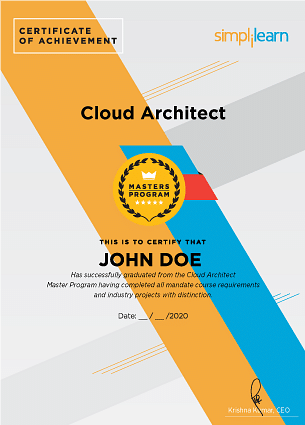
Get Ahead with Simplilearn's Master Certificate

Simplilearn Master Certificate
VIEW MORE

Tools Covered

app services aws lambda azure container service elastic beanstalk virtual machines azure cosmos db azure SQL database amazon inspector aws IAM aws kms azure IAM amazon elb amazon route 53 azure dns load balancer application gateway amazon efs amazon elastic block storage amazon s3 azure block blob azure storage disk amazon ec2

Our Learners

  • I'm a certified Azure Cloud Architect, thanks to Simplilearn's course. This deepened my understanding of Azure Cloud Architecture, enabling me to secure better IT consulting projects and achieve a 6% salary increase. Upskilling has opened doors for me in the thriving IT consulting sector, which offers abundant opportunities, in the United States.

    Read more Read less
    Benjamin Kates
  • I have been working with FIS for the past 12 years. My company in the United States decided to start a five-year project based on cloud, which was not there before. I felt an immediate need to take a course in cloud to handle projects easily. I wanted to explore more opportunities and thought upskilling would help me get a promotion.

    Read more Read less
    Rajesh Singh
  • I had an enjoyable learning experience with Simplilearn. Azure and AWS courses were very informative. The instructors were highly experienced and knowledgeable. I liked the recorded session and hands-on practice labs.

    Will Hendrickson
  • I chose Simplilearn particularly because of the live classes and videos; at the end of the day, the choice was a no-brainer. I was able to equate book knowledge to hands-on knowledge, helping me shore up my technology understanding. Moreover, the support that I got was unmatched and I highly recommend Simplilearn to my friends and colleagues.

    Read more Read less
    Jerry Stark
  • The journey with Simplilearn was highly impactful, with hands-on labs, expert instructors, and a structured curriculum that built strong cloud skills from scratch. It boosted my confidence and expertise, helping me transition into cloud architecture, secure a new role, and achieve a 60% salary hike.

    Read more Read less
    Dasetti Pavan Kumar
  • Simplilearn’s course helped me build cloud skills from scratch to an advanced level. After completing it, I received opportunities from reputed companies with a 100% salary increase. The interview guidance was excellent, and I now work as a Senior Consultant at Deloitte.

    Read more Read less
    Indranil Mondal
  • This course helped me a lot in changing my job, my profile and my domain. After I took the course in 2021, I got hired by Kalkine Limited with a 60 percent salary hike. After the course, I changed my job profile from IT support engineer to cloud engineer. And this year, I got promoted and became the Senior Cloud Engineer.

    Read more Read less
    Ankit Kumar Sharma
  • The training sessions provided thorough and valuable insights. The instructors demonstrated deep expertise and extensive experience. I am currently seeking roles within the field of cloud architecture after completing a cloud architect course.

    Oswald Samuel
  • The cloud architect course I completed proved instrumental in advancing my career. Shortly after joining my new company, I was promoted from Technical Lead to Skill Lead within eight months, accompanied by a substantial 25% salary increase. This certification was a pivotal factor in attaining this career milestone.

    Read more Read less
    Kaushik Dey
  • I chose Simplilearn for their comprehensive Cloud Architect course. It offered exactly what I needed. The instructors were knowledgeable and supportive, and the practice labs were invaluable for hands-on learning. Applying these skills led to a 30% salary increase and a promotion, thanks to Simplilearn's Cloud Architect course.

    Read more Read less
    Abhijeet Yadav

Request more information

We are looking into your query.
Our consultants will get in touch with you soon.
  • Acknowledgement
  • PMP, PMI, PMBOK, CAPM, PgMP, PfMP, ACP, PBA, RMP, SP, OPM3 and the PMI ATP seal are the registered marks of the Project Management Institute, Inc.

Request more information

For individuals
For business
Name*
Email*
Phone Number*
Your Message (Optional)
We are looking into your query.
Our consultants will get in touch with you soon.

A Simplilearn representative will get back to you in one business day.

First Name*
Last Name*
Work Email*
Phone Number*
Company*
Job Title*