
Automation Courses
Top 3 Automation Courses for 2026
Ranked by learner rating across our 50 Automation programs


Empowering Millions Through Professional Learning
- switchup4.6
- Trustpilot4.6Excellent
- Course Report4.5
Automation Skills You Will Build
The core capabilities you’ll practice across Automation programs
- Agile
- API Contract Testing
- API Testing with Postman
- AWS
- Basic XPathCSS Selectors
- Introduction to fine tuning concepts
- Java
- JDBC
- LLM fundamentals
- Multimodal prompts
- Performance Test Planning
- Prompt engineering
- TDD with TestNG
Universities and Technology Partners Behind These Programs



Free Business Process Automation Course with certificate
- 4.5 out of 5
- 600+ learners
- 6 Months
- Beginner
View more about Free Business Process Automation Course with certificate
Free Business Process Automation Course with certificate is an online certification course, rated 4.5 out of 5 by 600+ learners. Runs 6 Months. Best for beginners.
Free AI Automation Course for Beginners with Certificate
- 4.5 out of 5
- 200+ learners
- 6 Months
- Beginner
View more about Free AI Automation Course for Beginners with Certificate
Free AI Automation Course for Beginners with Certificate is an online certification course, rated 4.5 out of 5 by 200+ learners. Runs 6 Months. Best for beginners.
AI-Powered Automation Test Engineer Program
- 4.5 out of 5
- 3.5K+ learners
- 6 months
Cohort starts: 16th Oct ’26
- Intermediate to advanced
- Live cohort
View more about AI-Powered Automation Test Engineer Program
AI-Powered Automation Test Engineer Program is a live cohort certificate program, rated 4.5 out of 5 by 3.5K+ learners. Runs 6 months. Best for experienced practitioners.
Applied Digital Marketing: AI Analytics & Automation
- 4.5 out of 5
- 200+ learners
- 20 weeks
- Intermediate to advanced
View more about Applied Digital Marketing: AI Analytics & Automation
Applied Digital Marketing: AI Analytics & Automation is an online certificate program offered with Virginia Tech, rated 4.5 out of 5 by 200+ learners. Runs 20 weeks. Best for experienced practitioners.
AI-Powered Digital Marketing Certificate Program
- 4.9 out of 5
- 1.9K+ learners
- 5 months
Cohort starts: 21st Oct ’265 days left
- Intermediate to advanced
- Live cohort
View more about AI-Powered Digital Marketing Certificate Program
AI-Powered Digital Marketing Certificate Program is a live cohort certificate program offered with SP Jain School of Global Management, rated 4.9 out of 5 by 1.9K+ learners. Runs 5 months. Best for experienced practitioners.






Automation Overview
Industrial automation courses help develop practical skills. They guide you from mapping workflows to adding them to infrastructure and making sure they work as intended.
-
Skills developed include: Process decomposition, workflow logic, control rules, exception handling, system interaction awareness, and evaluation methodologies
-
Tools covered include: Java, Selenium, Python, UiPath, Automation Anywhere, Jenkins, Docker, and Maven
Automation courses support roles focused on creating, evaluating, and shipping automated features, such as:
-
Automation Engineer
-
RPA Developer
-
DevOps/Site Reliability Engineer (SRE)
-
Process Automation Consultant
-
Industrial Automation Specialist
-
MLOps/Workflow Deployment Associate
Startups to multinational corporations (MNCs) are now using automated systems to improve risk modeling, revenue growth strategies, and supply chain optimization. As a result, professionals who can move from concept to automation deployment are in high demand.
Automation is the process of using certain tools and processes to do repeatable tasks. In modern businesses, automation supports operations across cloud platforms and distributed systems, where manual testing becomes challenging.
As companies start using artificial intelligence and systems that work together, automation helps make things more reliable and efficient. It connects technical capability with measurable business outcomes, such as reduced operational errors and controlled process costs.
Know more about Automation Courses
Automation refers to the implementation or application side of software and systems management. It focuses on using rule-based logic, orchestration frameworks, and workflow tools to execute tasks without continuous manual input. In the modern setup, automation systems help with system scale, reliability, cost, and operational errors.
Our automation courses can help you learn to effectively execute automation across testing, deployment, and business workflows. Under guided instruction, you learn to design and deploy automated systems, evaluate performance, manage exceptions, and improve consistency across operations and infrastructure environments.
Manual Testing vs. Automation Training Courses
|
Aspect |
Manual Process Management |
Automation Training Courses |
|
Execution |
Relies on human-led repetitive actions and manual checks |
Focuses on script-based execution and rule-based orchestration |
|
Learning Path |
Centers on domain knowledge and standard operating processes |
Emphasizes on workflow logic, programming languages(Java/Python), and tools |
|
Core Objective |
Maintaining status quo operations through direct intervention |
Delivering "Lights Out" operations and quick deployment pipelines |
|
Key Tools |
JIRA, Excel, and manual test suites |
Selenium, UiPath, Jenkins, and Docker |
Automation skills are important as organizations take initiatives to scale data-driven systems and intelligent workflows. From robotic process automation (RPA) and CI/CD pipelines to control systems, automation is now supporting measurable business performance. Our industrial automation courses will help you develop the confidence to manage these systems correctly and stay competitive in today’s job market.
What is the Market Demand for Automation Systems?
Automation systems have now become a part of day-to-day operations globally.
|
Market Growth The automation testing market is valued at $40.44 billion in 2026, with a projected CAGR of 14.32% through 2031. |
Industrial Scale The industrial automation sector is estimated to reach $233.6 billion this year. |
Intelligent Systems Over 88% of organizations now use AI in at least one business function to enhance their automated workflows. |
As enterprises modernize infrastructure and scale digital operations, demand for professionals who can design, implement, and maintain automated systems is increasing.
How Simplilearn Makes You Industry-Ready?
Online automation programs will help you understand the complete “design–automate–orchestrate” workflow.
Our expert-led courses offer guided labs and projects that reflect actual deployment and testing environments. We aim to provide practical learning and foundational understanding of concepts so that your skills stay relevant amid changing trends. The learning path includes electives so you can customize what you want to learn based on your goals.
Why Learn Automation Technologies With Simplielarn?
We offer job-focused automation learning to help you advance in testing, DevOps, or process automation positions. The curriculum includes an Automation Foundations module for beginners or learners who need to understand the basics before moving to advanced automation frameworks.
Our online automation testing courses are offered in partnership with reputed global institutions and include live, instructor-led sessions and project-based exposure to widely used automation tools. Upon completion, you will receive an industry-recognized certificate and career support services, such as interview preparation and resume guidance.
Connect with our learning consultant to get all your questions answered about programs, faculty, and more
Tools and Platforms Used in Our Automation Courses
Get hands-on with the platforms and tools covered across our Automation programs



















.png)





Recommended Learning Materials for Upskilling
Explore free webinars, tutorials, career guides, and practical reads to go deeper
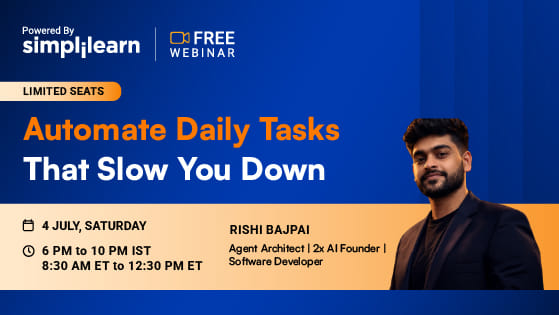
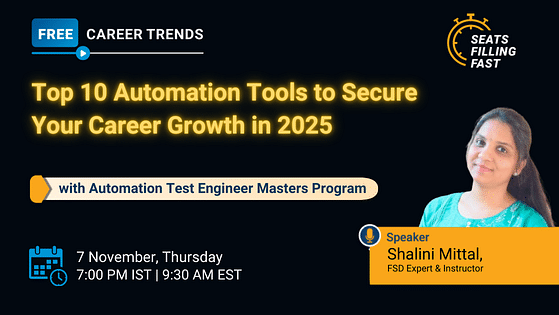
Upcoming Webinars - Free Masterclasses

Articles and Ebooks That You Can Access For Free


Automation Courses: Frequently Asked Questions
When evaluating automation certification courses, look for the ones that teach how automation is applied in actual operational environments. Crucial factors to consider include coverage of task logic, workflow control, and exception handling.
The best automation courses online provide opportunities for hands-on practice through cloud labs and industry-aligned projects. You may also look for a structured learning path that includes career support services and recognized program credentials, as these provide additional value.
Yes, they can, as automation courses offer applied learning, which is focused on using technology to solve business problems, not just writing code. For those in non-technical roles, the value lies in learning how to:
-
Identify high-impact use cases for robotic process automation (RPA)
-
Define success metrics, such as error reduction
-
Choose between rule-based automation and AI-driven workflows
-
Manage operational risk, including privacy and compliance checks
Yes, our automation courses include hands-on work because the goal is to learn/practice the whole process from start to finish. You will learn by working on projects and see how to get data ready, create scripts to run tasks, check if the results are correct, and get everything ready to use in actual situations. These projects help you practice steps like fixing errors and making sure different parts of the system work together.
The time taken to complete an automation certification program depends on its depth and format.
Short, self-paced courses can be completed in a few weeks. However, structured professional programs and bootcamps typically run between 4 and 7 months. Our automation programs often require 8–10 hours of effort per week; they include live instruction and project work to ensure you have a strong portfolio.

*All salary figures referenced are based on data reported by employees on Glassdoor. These figures are estimates and may vary depending on location, experience level, company policies, and market conditions. Actual compensation may differ.